Local LLMs vs Hosted APIs
A comparison of running open-weight models on your own hardware versus renting commercial models by the token.
Verdict: Start with Hosted APIs to validate your product quickly; migrate to Local LLMs when data privacy is strictly mandated or inference volume makes per-token pricing prohibitive.
The Short Answer
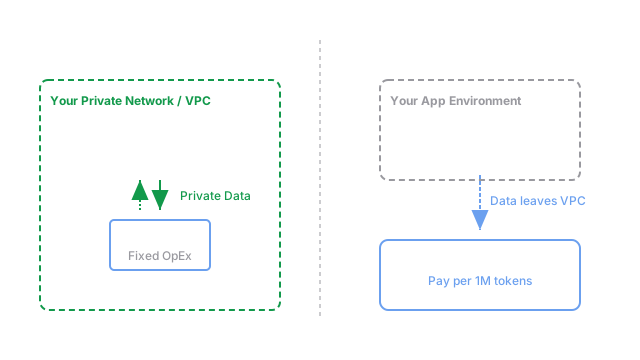
Local LLMs (like Llama 3 via Ollama or vLLM) run entirely on your own hardware. You pay upfront or fixed hourly costs for the compute, but your data never leaves your environment. Hosted APIs (like OpenAI, Anthropic, or Gemini) are fully managed models accessed over the internet. You pay a variable cost per token processed, trading data privacy and control for immediate access to frontier intelligence with zero operational overhead.
Where They Differ
| Feature | Local LLMs (Ollama, vLLM) | Hosted APIs (OpenAI, Anthropic) |
|---|---|---|
| Data Privacy | Absolute (runs in your VPC/hardware) | Data is sent to third-party servers |
| Pricing Model | Fixed CapEx/OpEx (hardware/VM rental) | Variable OpEx (pay per 1M tokens) |
| Latency | Dependent on your hardware capabilities | Low but subject to network & API limits |
| Intelligence | Capped by open-weight model capabilities | Frontier capabilities (complex reasoning) |
| Operational Burden | High (DevOps, scaling, updates) | Zero (API key and go) |
Choose Local LLMs When
- Data privacy is non-negotiable: You are building for healthcare, defense, or handling proprietary corporate data that legally cannot leave your network.
- You have massive, sustained inference volume: If you process millions of tokens continuously, the fixed cost of renting GPUs is drastically cheaper than paying a provider's API markup.
- You need offline availability: Your application runs on edge devices, in air-gapped environments, or requires guaranteed uptime without external dependencies.
- You need deep customization: You want to run highly specialized fine-tunes (like LoRA adapters) that aren't supported by standard API providers.
Choose Hosted APIs When
- You are validating a new product: You want to reach product-market fit quickly without spending weeks configuring CUDA drivers or provisioning expensive GPUs.
- You need state-of-the-art reasoning: Your task requires the absolute highest level of intelligence, coding ability, or complex instruction following that open models have not yet matched.
- Traffic is highly variable or bursty: You have unpredictable usage patterns where maintaining constantly running GPUs would result in significant idle costs.
- You lack MLOps expertise: Your team consists of application developers rather than infrastructure engineers, and you want to focus entirely on the product layer.
What People Get Wrong
Assuming Local LLMs are always cheaper.
It is a common misconception that because the model weights are free, running a Local LLM is cheaper than an API. If your application only serves a few requests an hour, a dedicated $3/hr GPU instance will cost far more than the pennies you would spend on API tokens. Local hosting only becomes cheaper when your volume is high enough to keep the hardware constantly saturated.