Convai Laya vs. TypeSafe Jev
Settling the decision between self-hosting an open-weights System 1 router (Laya) and using a fully managed, hosted API (Jev) for low-latency triage.
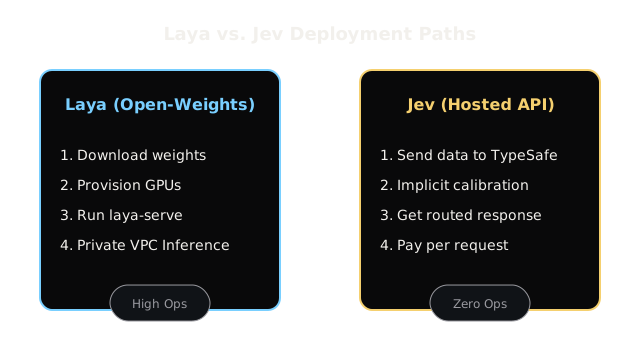
Verdict: Use Laya if you need absolute control, data privacy, or ultra-low network latency. Use Jev if you want zero-ops setup and don't want to manage GPU infrastructure.
The Short Answer
Both Convai's Laya and TypeSafe's Jev are System 1 decision models. They replace slow, text-generating LLMs with fast, single-pass encoders that output typed decisions (Choice, Score, Noul). The difference is entirely about deployment and control. Laya is open-weights (Apache 2.0) and requires you to host and fine-tune it yourself. Jev is a closed, hosted API that works out of the box but charges per request and requires sending your data over the network.
Where They Differ
| Dimension | Laya (Convai) | Jev (TypeSafe) |
|---|---|---|
| Availability | Open-weights (Apache 2.0) | Hosted API (Closed) |
| Inference Cost | Infrastructure cost only | Per-token or per-request API fee |
| Latency | <50ms (Zero network hop if collocated) | ~100-200ms (Network overhead applies) |
| Data Privacy | 100% Private (Runs in your VPC) | Data is sent to TypeSafe servers |
| Fine-Tuning | Required for high accuracy (RLCD) | Handled implicitly / via API |
| Multilingual | Yes (via mmBERT-base checkpoint) | Yes |
Choose Laya (Open-Weights) When
- You have strict data privacy requirements: If you are routing medical records (HIPAA) or internal financial data, you cannot send raw states to a third-party API.
- Latency is the absolute priority: By collocating Laya with your application servers, you eliminate the network hop.
- You want to fine-tune heavily: You have a massive proprietary dataset and want to distil a teacher model to fine-tune Laya specifically for your domain using proper scoring rules.
Choose Jev (Hosted API) When
- You want a zero-ops solution: You do not want to manage GPU instances, deal with
laya-serve, or handle TensorFlow/PyTorch dependencies. - You need immediate results: You don't have the time to distil data and fine-tune a model before deploying.
- Traffic is spiky: You prefer a pay-as-you-go model rather than paying for idle T4 instances during low-traffic periods.
What People Get Wrong
Comparing Zero-Shot to Hosted Performance A common mistake is evaluating Laya's zero-shot performance against Jev's API. Laya's zero-shot accuracy on typed-decisions is often near random (e.g., 0.362). The high accuracy figures (0.766+) require you to actively distil data and fine-tune it. Jev feels "smarter" out of the box, but a properly fine-tuned Laya will match or beat it on your specific domain.