Decision Models vs. Generative LLMs
When to use a fast, non-generative System 1 router instead of a massive System 2 autoregressive LLM for classification and intent routing.
Verdict: Use a Decision Model for routing, triaging, and metadata extraction. Use a Generative LLM for reasoning, summarizing, and writing.
The Short Answer
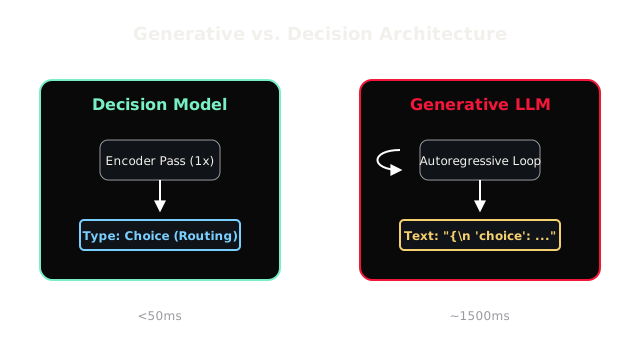
Generative LLMs (System 2) are incredibly capable but inherently slow because they generate probabilistic text one token at a time. Decision models (System 1), like Laya or Jev, don't generate text at all. They use an encoder to read the input in a single pass and output deterministic, typed decisions (like a category or a confidence score) in milliseconds.
Where They Differ
| Dimension | Decision Models (e.g., Laya) | Generative LLMs (e.g., GPT-4) |
|---|---|---|
| Output Type | Typed structures (Choice, Score, Boolean) | Free-form probabilistic text |
| Generation Mechanism | Single forward pass (Non-autoregressive) | Token-by-token (Autoregressive) |
| Latency | Extremely low (~30-50ms) | High (Often 1000ms+) |
| Hallucination Risk | Zero (Does not generate text) | Present (Requires JSON parsing/retries) |
| Primary Use Case | Routing, triage, classification | Reasoning, summarization, writing |
| Calibration | High (Often trained with RLCD) | Varies (Often overconfident) |
Choose Decision Models (System 1) When
- You are building an agent router: You need to decide whether a user request should go to a database lookup, an expensive LLM, or a human.
- The output is purely categorical: You need to classify an email's intent, extract a severity score, or flag toxicity.
- Latency is critical: The user is waiting on the UI, and every millisecond of decoding time degrades the experience.
- JSON parsing failures are unacceptable: You need absolute deterministic types without writing regex to fix broken JSON.
Choose Generative LLMs (System 2) When
- You need to synthesize new information: The task requires writing an email, generating code, or summarizing a long document.
- The decision requires complex reasoning: The task isn't just pattern matching; it requires chain-of-thought to arrive at the answer.
- You don't have labeled training data: You need a model that can perform reasonably well zero-shot with just a clever prompt.
What People Get Wrong
Using LLMs for Everything
The biggest mistake in modern AI engineering is defaulting to an LLM for every problem. Throwing a 100-billion parameter autoregressive model at a simple classification task is like using a supercomputer to calculate a tip. It wastes compute, introduces latency, and creates fragile pipelines that break when the LLM outputs ```json instead of raw JSON.