Comparison
Logistic Regression vs SVM
Comparing calibrated probability outputs with maximum margin decision boundaries.
Verdict: Use Logistic Regression when you need to know the exact probability of a classification; use SVMs when you only care about drawing the most robust boundary between classes, particularly in high dimensions.
Quick Version (TL;DR)
Comparing calibrated probability outputs with maximum margin decision boundaries.
The Short Answer
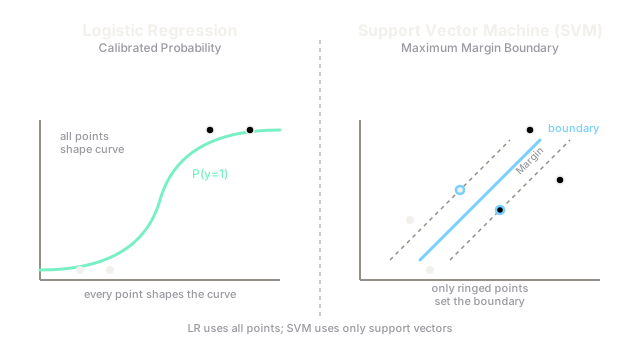
Despite the name, Logistic Regression is a classification algorithm. It uses a sigmoid curve to output the exact probability that a data point belongs to a class, taking every single data point into account. A Support Vector Machine (SVM) does not output probabilities; it focuses entirely on drawing a hard line (hyperplane) that maximizes the margin (distance) between the closest points of the opposing classes.
Where They Differ
| Feature | Logistic Regression | SVM |
|---|---|---|
| Output Type | Continuous Probability (e.g., 82% sure it's a cat) | Discrete Prediction (e.g., It is a cat) |
| Loss Function | Log Loss (Cross-Entropy) | Hinge Loss |
| Influence of Data | All data points affect the boundary | Only the closest points (Support Vectors) affect the boundary |
| Non-Linear Data | Requires manual feature engineering | Easily handled via the Kernel Trick |
Choose Logistic Regression When
- You need calibrated probabilities: In domains like finance (credit scoring) or medicine, predicting "Yes" or "No" isn't enough. You need to know if the model is 51% confident or 99% confident to evaluate risk.
- You need interpretability: The weights in logistic regression tell you exactly how much each feature increases or decreases the log-odds of the outcome.
Choose SVM When
- You have highly complex, non-linear boundaries: SVMs shine because of the "Kernel Trick", which projects data into higher dimensions without actually computing the coordinates. This allows SVMs to draw complex, squiggly boundaries in the original space very efficiently.
- You are working in high dimensions with little data: For text classification (TF-IDF) or gene expression data where there are more features than samples, SVMs are highly robust against overfitting because they only care about the support vectors.
What People Get Wrong
People often try to extract probabilities from an SVM (using Platt scaling), which forces the model to fit a logistic regression over the SVM outputs. This is computationally expensive and often results in poorly calibrated probabilities. If you absolutely need a probability, you should start with Logistic Regression.