Comparison
SQL vs NoSQL
A practical guide to choosing between relational SQL and schema-less NoSQL databases for storing and serving machine learning datasets.
Verdict: Use SQL for structured tabular data and analytical queries; use NoSQL for unstructured data, rapid ingestion, and document-heavy ML pipelines.
Quick Version (TL;DR)
A practical guide to choosing between relational SQL and schema-less NoSQL databases for storing and serving machine learning datasets.
The Short Answer
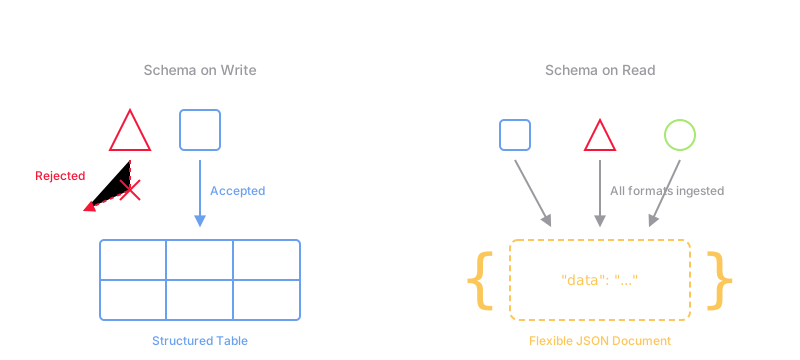
SQL (Relational) databases organize data into rigid tables with predefined schemas. They validate every record on ingestion. NoSQL databases (like Document or Key-Value stores) are schema-flexible, ingesting JSON payloads or unstructured logs without requiring you to declare columns up front.
Where They Differ
| Feature | SQL (Relational) | NoSQL (Document / Key-Value) |
|---|---|---|
| Schema Definition | Schema-on-write (strict) | Schema-on-read (flexible) |
| Data Structure | Tabular (Rows and Columns) | JSON, Key-Value, or Wide-Column |
| Primary Scaling | Vertical (Bigger machine) | Horizontal (More machines) |
| Joins | Fast and fundamental | Slow or non-existent; requires denormalization |
| ML Data Role | Complex analytics, feature engineering | High-throughput logging, unstructured collection |
Choose SQL When
- You are building feature matrices: SQL's powerful aggregations and joins let you easily create complex group-by features (e.g., user average spend over 30 days) directly in the database.
- Your data shape is stable: If your data maps perfectly to a strict tabular format and rarely changes its schema, a relational model protects data integrity by dropping malformed records.
- ACID transactions matter: If you are dealing with financial transactions where losing a single record is catastrophic, SQL guarantees consistency.
Choose NoSQL When
- You are capturing highly variable raw events: When logging clickstreams, app telemetry, or scrape results where new attributes appear daily, a document store simply accepts the new fields without breaking.
- You need massive write throughput: Distributed NoSQL systems can horizontally scale to absorb millions of events per second far more easily than a single relational database.
- You are storing hierarchical data: If your pipeline processes deeply nested data like user behavior profiles, flattening them into relational tables destroys their natural structure.
What People Get Wrong
Assuming NoSQL is faster for ML pipelines
People often choose NoSQL because they've heard it is "web-scale." While it ingests data extremely fast, reading and joining that data back out for an ML training pipeline is often much slower and more complex if the data isn't perfectly structured for the query you're making. SQL databases are highly optimized for reading complex joins.
Using NoSQL to avoid thinking about schema
Choosing NoSQL doesn't eliminate schemas; it just defers them. "Schema on read" means the ML engineer writing the flattening pipeline will have to invent the schema and handle missing fields, type mismatches, and nested chaos. You are moving the work, not deleting it.