Comparison
MHA vs MQA vs GQA vs MLA
Comparing attention mechanisms and their impact on KV-cache memory.
Verdict: Use GQA as the modern default to balance quality and inference cost; use MLA when working with extreme long-context regimes to drastically compress the KV cache.
Quick Version (TL;DR)
Comparing attention mechanisms and their impact on KV-cache memory.
The Short Answer
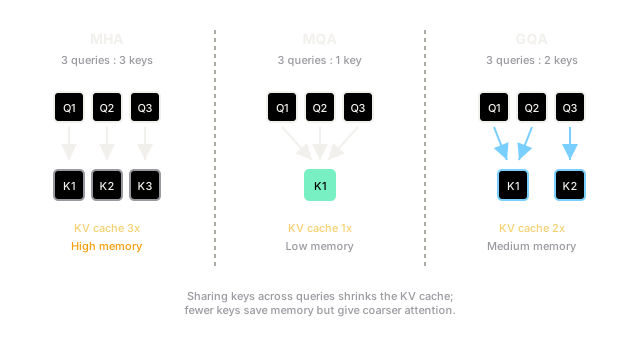
The KV Cache (storing past keys and values during generation) is the primary memory bottleneck in LLM inference. Multi-Head Attention (MHA) creates independent keys/values for every query head, blowing up memory. Multi-Query Attention (MQA) forces all queries to share a single key/value pair, degrading quality. Grouped-Query Attention (GQA) strikes a balance, and Multi-Head Latent Attention (MLA) uses low-rank projections to compress it entirely.
Where They Differ
| Feature | MHA | MQA | GQA | MLA |
|---|---|---|---|---|
| Mechanism | N queries N keys | N queries 1 key | N queries G keys | N queries 1 latent vector |
| KV Cache Size | Massive | Tiny | Moderate | Extremely Small |
| Model Quality | Highest baseline | Noticeable degradation | Almost identical to MHA | Near MHA quality via projection |
| Primary Use Case | Older models (GPT-3) | Edge/Fast models | Modern defaults (Llama 3) | DeepSeek-V2 / extreme contexts |
Choose MHA When
- You are training small models: When parameters are small (), the KV cache isn't the primary bottleneck, and giving the model maximum expressivity via full MHA yields the best results.
Choose GQA When
- You are building a general-purpose LLM: Grouped-Query Attention is the industry standard today (used in Llama 2/3, Mistral, etc.). It provides 99% of the quality of MHA while reducing the KV cache footprint by a factor of 4x to 8x, allowing much larger batch sizes during serving.
Choose MLA When
- You are serving 100k+ token contexts: Multi-Head Latent Attention (introduced by DeepSeek) projects the KV cache into a tiny latent space, decoding it on the fly. This allows you to serve massive context windows without dedicating hundreds of gigabytes of VRAM to the cache.
What People Get Wrong
People often think attention memory scales primarily with the parameter size of the model. In reality, KV cache memory scales strictly with the batch size × context length × number of KV heads. A 7B parameter model using MHA can easily run out of VRAM faster than a 70B parameter model using GQA if the context window is large enough.