Comparison
Multi-Class vs Multi-Label
The difference between picking exactly one answer from many, versus picking any number of answers at once.
Verdict: Multi-Class forces the model to choose one dominant category; Multi-Label lets categories coexist independently.
Quick Version (TL;DR)
The difference between picking exactly one answer from many, versus picking any number of answers at once.
The Short Answer
Both terms deal with classification problems involving more than two categories, but they answer fundamentally different questions.
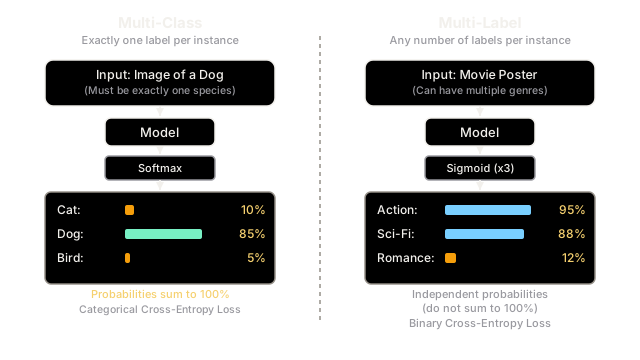
Multi-class classification asks: "Out of all these options, which single category does this belong to?" For example, an image of an animal is either a dog, a cat, OR a bird. It cannot be more than one.
Multi-label classification asks: "For each of these options, does it apply or not?" For example, a movie can be Action, Sci-Fi, AND a Comedy all at once, or none of them. The labels are not mutually exclusive.
Where They Differ
| Feature | Multi-Class | Multi-Label |
|---|---|---|
| Label Mutually Exclusive? | Yes. An item can only have one label. | No. An item can have zero, one, or many labels. |
| Probability Constraint | All probabilities must sum exactly to 1. | Probabilities are independent (each is between 0 and 1). |
| Final Layer Activation | Softmax (pushes one score high, forces others down). | Sigmoid (evaluates each class independently). |
| Loss Function | Categorical Cross-Entropy. | Binary Cross-Entropy (calculated per label). |
| Real World Example | Predicting handwritten digits (0-9). | Tagging a blog post (Tech, AI, Coding). |
Architectural Consequences
The distinction between these two isn't just conceptual; it changes how you build the neural network.
Multi-Class Architecture
Because the classes are mutually exclusive, they compete with one another. We enforce this competition using the Softmax activation function at the final layer. Softmax takes the raw output scores and squashes them so they sum to 1.0 (100%). If the probability of "Dog" goes up, the probability of "Cat" must go down.
Multi-Label Architecture
Because classes can coexist, there is no competition. We use a Sigmoid activation function on each output neuron independently. The network is essentially answering a series of binary Yes/No questions: Is it Action? (Yes: 90%), Is it Sci-Fi? (Yes: 80%), Is it Romance? (No: 10%).
Choose A When
(When to use Multi-Class)
- Categories are physically or logically exclusive: E.g., A tumor cannot be both "benign" and "malignant". A transaction cannot be both "fraudulent" and "legitimate".
- You need absolute certainty on one outcome: E.g., A self-driving car classifying a traffic light as Red, Yellow, or Green.
Choose B When
(When to use Multi-Label)
- You are building tagging systems: Categorizing products, articles, or videos where multiple attributes apply simultaneously.
- You are diagnosing multiple conditions: A patient might have pneumonia and diabetes.
- Identifying objects in a scene: An image might contain a car, a pedestrian, and a stop sign.
What People Get Wrong
Using Softmax for Multi-Label
A common bug for beginners is using CategoricalCrossentropy loss and Softmax activation when they actually have a multi-label dataset. The network will desperately try to pick the single best label and suppress the others, ruining the accuracy for the secondary labels.
Confusing Multi-Class with Multi-Variate
Multi-variate refers to having multiple input features (e.g., predicting house price based on square footage, bedrooms, and zip code). Multi-class refers to having multiple possible output categories.