Comparison
Reasoning Model vs Standard Model
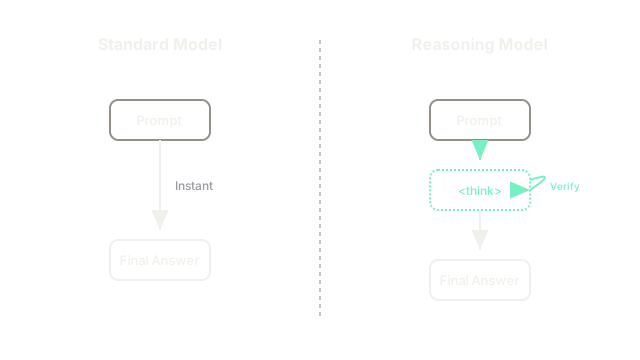
Comparing standard autoregressive generation with inference-time scaling (test-time compute).
Verdict: Use a Standard Model for fast, intuitive tasks like summarizing or chatting; use a Reasoning Model when solving complex math, logic puzzles, or deep coding problems that require planning.
Quick Version (TL;DR)
Comparing standard autoregressive generation with inference-time scaling (test-time compute).
The Short Answer
A Standard Model (like GPT-4o or Llama-3) is trained to predict the next word immediately. It relies on its internalized intuition and pre-training to spit out an answer in one go. A Reasoning Model (like OpenAI o1 or DeepSeek-R1) uses Reinforcement Learning to explicitly pause, think, verify its own work, and correct mistakes in a hidden "scratchpad" before finally showing you the answer.
Where They Differ
| Feature | Standard Model | Reasoning Model |
|---|---|---|
| Generation Style | Immediate autoregressive output | Generates a long chain of thought first |
| Latency | Low (Starts streaming immediately) | High (Often "thinks" for 10-60 seconds) |
| Inference Cost | Low | High (You pay for all the hidden thinking tokens) |
| Best Used For | Knowledge retrieval, summarization, casual chat | Math, logic, complex coding, algorithm design |
Choose A Standard Model When
- You are building user-facing chatbots: Users expect instant replies. If a user asks "What is your refund policy?", a reasoning model will waste 15 seconds "thinking" about the best way to structure the answer, whereas a standard model will output it instantly and flawlessly.
- You are doing extraction or summarization: Reading a document and extracting JSON does not require deep, multi-step logic.
Choose A Reasoning Model When
- You need extreme accuracy on complex problems: If you ask a model to write a full Python script to solve a Sudoku puzzle, a standard model will start writing code immediately and often paint itself into a corner. A reasoning model will spend 30 seconds planning the algorithm, realizing its first plan won't work, fixing it, and only then generating the final code.
- You are leveraging Test-Time Compute: Reasoning models unlock a new scaling law — giving the model more time to "think" at inference time linearly improves its accuracy on hard benchmarks (like AIME or Codeforces).
What People Get Wrong
People often try to prompt standard models to "think step by step" (Chain of Thought prompting). While this helps slightly, it is fundamentally different from a true Reasoning Model. A true reasoning model is heavily trained via Reinforcement Learning (RL) to explicitly explore multiple paths, backtrack when it hits a dead end, and optimize for the final reward, rather than just spitting out a static template of steps.