Comparison
Small vs Large Models
Comparing latency and task fit across model sizes.
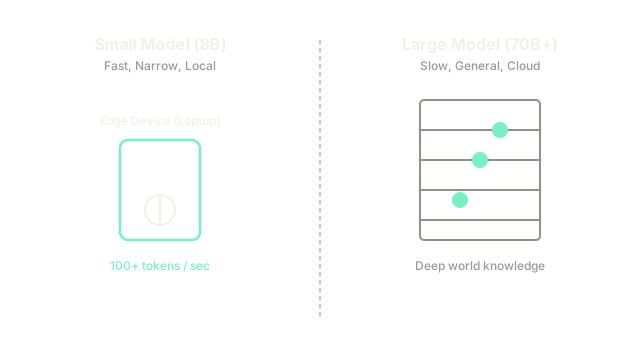
Verdict: Use Large Models (70B+) for deep reasoning, coding, and complex generation; use Small Models (1B - 8B) for fast, hyper-specific tasks like routing, classification, or edge device deployment.
Quick Version (TL;DR)
Comparing latency and task fit across model sizes.
The Short Answer
Small Language Models (SLMs), usually ranging from 1 billion to 8 billion parameters, are lightweight enough to run on a laptop or smartphone. They lack deep general knowledge but are incredibly fast. Large Language Models (LLMs) (70 billion to 1+ trillion parameters) possess vast world knowledge and reasoning capabilities but require expensive clusters of GPUs to run and take longer to generate text.
Where They Differ
| Feature | Small Models (<8B) | Large Models (70B+) |
|---|---|---|
| Deployment | Laptops, Mobile phones, Raspberry Pi | Cloud Datacenters |
| Latency (Speed) | Lightning fast (100+ tokens/sec) | Slower (20-50 tokens/sec) |
| World Knowledge | Very limited (hallucinates facts) | Extensive |
| Best Used For | Text routing, classification, summarization | Coding, logic, writing, complex instruction following |
Choose Small Models When
- You are doing a highly specific, repeatable task: If you just need a model to read an incoming email and output
{"intent": "refund"}or{"intent": "complaint"}, using GPT-4 is absurd overkill. A fine-tuned 8B model will do this 10x faster and 100x cheaper with the same accuracy. - You are building local or offline apps: If you want a helpful assistant integrated into an iOS app that works without internet, you must use a quantized SLM.
Choose Large Models When
- You need zero-shot reasoning: Large models are incredibly good at generalizing to tasks they haven't seen before. If you want a model to write a Python script that integrates three obscure APIs, a small model will fail instantly. A 70B+ model has the capacity to reason through the problem.
- You need accurate world knowledge: Large models memorize a massive amount of the internet during pre-training. While both sizes hallucinate, an 8B model simply doesn't have the parameters to store historical dates, complex scientific facts, or obscure trivia.
What People Get Wrong
People often assume SLMs are "dumber" across the board. While they lack general reasoning, SLMs actually have a much higher performance ceiling on narrow tasks if you fine-tune them. A 3B parameter model fine-tuned on 10,000 examples of your company's specific JSON schema will outperform a zero-shot 1Trillion parameter frontier model on that exact task, while costing pennies to run.