Comparison
Supervised vs Unsupervised vs Self-Supervised
Understanding the three fundamental learning paradigms based on where the label comes from.
Verdict: It depends entirely on where your labels come from: humans, nowhere, or the data itself.
Quick Version (TL;DR)
Understanding the three fundamental learning paradigms based on where the label comes from.
The Short Answer
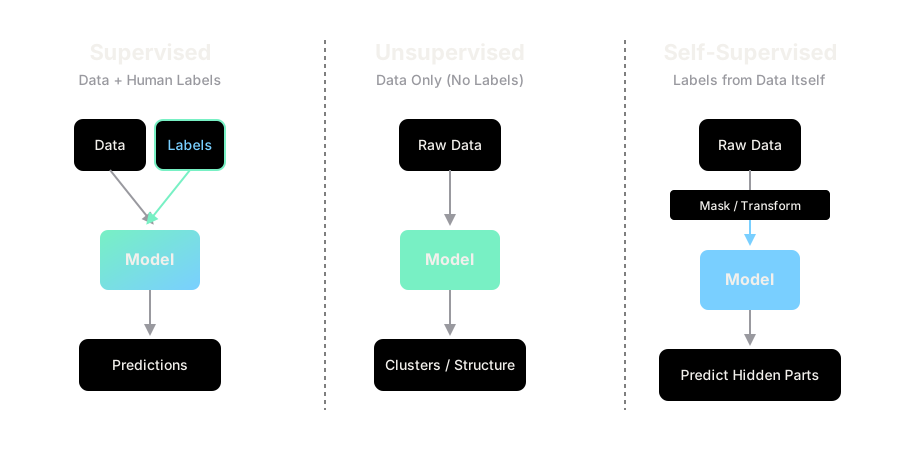
The difference between these three paradigms comes down to one question: Where do the labels come from?
- Supervised Learning: A human provides the labels (e.g., tagging photos as "cat" or "dog").
- Unsupervised Learning: There are no labels at all. The model just looks for inherent structure or clusters (e.g., grouping customers by purchasing habits).
- Self-Supervised Learning: The data provides its own labels. The algorithm hides part of the input and asks the model to predict the hidden part (e.g., predicting the next word in a sentence).
Where They Differ
| Feature | Supervised | Unsupervised | Self-Supervised |
|---|---|---|---|
| Label Source | Human annotators or existing databases. | None. | Automatically generated from the data. |
| Goal | Map input X to output Y. | Discover hidden patterns in X. | Learn a rich representation of X. |
| Classic Algorithms | Random Forests, SVMs, CNNs. | K-Means, PCA, Autoencoders. | Transformers (BERT, GPT), SimCLR. |
| Data Bottleneck | Cost and time of human labeling. | Defining what a "good" cluster means. | Compute cost of training on massive datasets. |
| Typical Use Case | Spam detection, image classification. | Customer segmentation, anomaly detection. | Pre-training Large Language Models (LLMs). |
Choose Supervised When
- You have a specific target to predict: You know exactly what you want the model to output (e.g., predicting the sale price of a house).
- You have high-quality labeled data: You already possess a dataset where the "answers" are known.
- Accuracy on a narrow task is paramount: You need a highly accurate model for a well-defined problem, like medical diagnosis.
Choose Unsupervised When
- You have lots of data, but no labels: You want to extract value from a massive dataset without paying humans to tag it.
- You want to discover unknowns: You suspect there are groupings in your data, but you don't know what they are in advance (e.g., discovering new buyer personas).
- You need to reduce dimensionality: You want to compress your data (like with PCA) before feeding it to another algorithm.
Choose Self-Supervised When
- You are training a foundation model: You want to build a model that understands language or vision generally, which can later be fine-tuned.
- You have internet-scale data: You have billions of words of text or millions of unlabelled images.
- The context contains the answer: The data has temporal or spatial structure that allows predicting parts from other parts (e.g., predicting a missing word in a paragraph, or a missing patch in an image).
What People Get Wrong
Thinking Self-Supervised is just Unsupervised
While neither requires human labels, they have different goals. Unsupervised learning tries to find inherent structure (clusters). Self-supervised learning uses a clever trick to create a supervised task out of unlabelled data (predict the next word) to learn robust representations.
Assuming you only need one
Modern AI systems often use all three. An LLM might be pre-trained using self-supervised learning, fine-tuned using supervised learning (RLHF), and might use unsupervised clustering to group anomalous user prompts in production.