Comparison
U-Net vs Diffusion Transformer
Comparing convolutional downsampling with patch-based transformer blocks for diffusion.
Verdict: Use U-Nets for efficiency at lower resolutions; use Diffusion Transformers (DiT) when scaling to massive parameter counts for high-fidelity, high-resolution generation.
Quick Version (TL;DR)
Comparing convolutional downsampling with patch-based transformer blocks for diffusion.
The Short Answer
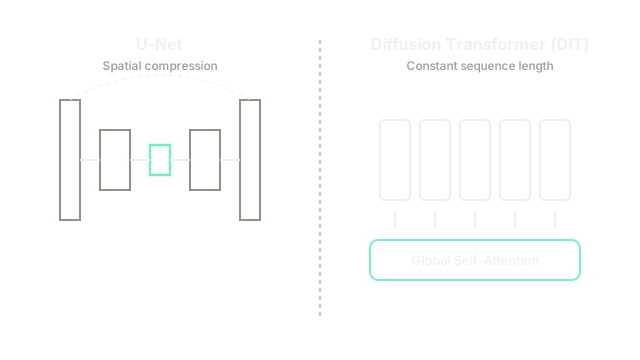
Early diffusion models (like Stable Diffusion 1.5) relied on the U-Net architecture, which uses convolutions to shrink the image spatially, process it, and expand it back up. Diffusion Transformers (DiT), popularized by Sora and Stable Diffusion 3, discard convolutions entirely. They slice the image into patches and process them globally using a standard Transformer, unlocking massive scaling capabilities.
Where They Differ
| Feature | U-Net | Diffusion Transformer (DiT) |
|---|---|---|
| Spatial Processing | Downsamples and Upsamples | Keeps spatial resolution constant (patches) |
| Core Operation | Convolutions + localized attention | Pure self-attention across patches |
| Scalability | Plateaus (hard to scale past a few billion parameters) | Highly scalable (predictable improvements with scale) |
| Inductive Bias | High (assumes 2D pixel locality) | Low (treats patches as an arbitrary sequence) |
Choose U-Net When
- You are running on edge devices: U-Nets are inherently lighter and faster because they compress the spatial dimensions of the image in the middle layers, requiring far fewer FLOPs than computing attention over every patch.
- You are doing medical imaging segmentation: The U-Net was originally invented for segmentation, and its skip connections remain unparalleled at precisely outlining local structures.
Choose DiT When
- You are training a frontier generative model: The scaling laws for Transformers are well understood. If you have the compute to train a 10B+ parameter model, DiT will smoothly absorb that compute and translate it into higher quality, whereas U-Nets hit a ceiling.
- You are generating video: Video is fundamentally just a 3D volume of patches (height, width, time). DiTs can naturally attend across time and space simultaneously without complex 3D convolutions.
What People Get Wrong
People assume that because DiT uses patches, it can't understand fine details. In reality, because DiTs lack the forced compression bottleneck of a U-Net, they often preserve high-frequency details (like text and fine textures) much better than U-Nets, provided they are trained on enough data to overcome their lack of inductive bias.