Adapters for Vision Tuning
Slide small down-up bottlenecks into frozen layers and train only them. A few percent of weights adapts big vision.
Why Does This Exist?
Full copies per task bloat storage. Adapters keep one frozen backbone and store percent task weights as bottlenecks after attention and MLP. Fine-tuning becomes swapping small files.
This page covers vision adapters only. Prompt tokens are sibling pages.
The one idea you need first.
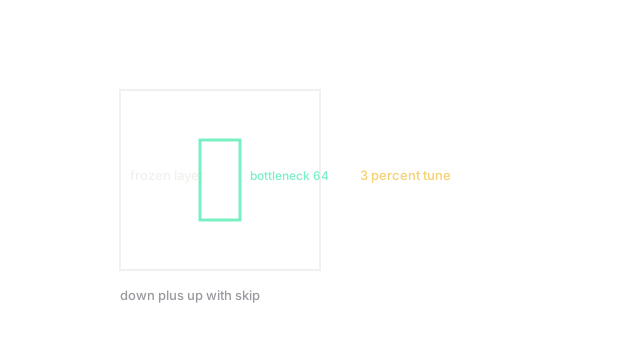
Adapter is down to , nonlinearity, up back, plus skip: . Only learn. Place after attention and MLP per block.
Think of It Like This
Plug-in pedals on a shared guitar rig
A guitarist keeps one amp rig and clips pedals for rock versus jazz. Pedals shape tone without rewiring the amp, and each gig bag holds its own set.
Backbone is the rig, adapters are pedals, and skips keep clean tone underneath. Where it stops: pedals cannot fix a broken amp, so huge shifts still retune.
How It Actually Works
Freeze ViT . Insert adapters in each block. Train adapters plus head on task data. Bottleneck sets size; larger helps hard shifts. Store adapters per task and compose by swapping.
In plain words: narrow, bend, widen, then add back to the stream.
Worked example
ViT-B M: adapters M, about percent. Pets accuracy versus full, gap . Ten tasks store M versus M full copies, a x saving. The math favors adapters past three tasks.
Watch Out For
Adapters too narrow for large shifts
Rank starves sketch-to-photo jumps and gaps hit points. Tuning stalls while loss looks fine. Raise to or for far shifts before judging adapters.
The Quick Version
- Adapters are down-up bottlenecks with skips in frozen layers.
- Rank 64 with 3 percent weights suits most tasks.
- Place after attention and MLP blocks.
- Swap small files per task.
- Widen rank for far domain shifts.