Prompt Tuning Soft Tokens
Learn twenty vectors that sit before frozen model inputs. Words stay fixed while the soft prefix steers answers.
Why Does This Exist?
Hand prompts plateau and full tuning costs much. Twenty learned vectors steer frozen joint models per task with kilobytes stored. Zero-shot classification prompts become trained vectors here.
This page covers text-side soft tokens only. Vision tokens are the prior page.
The one idea you need first.
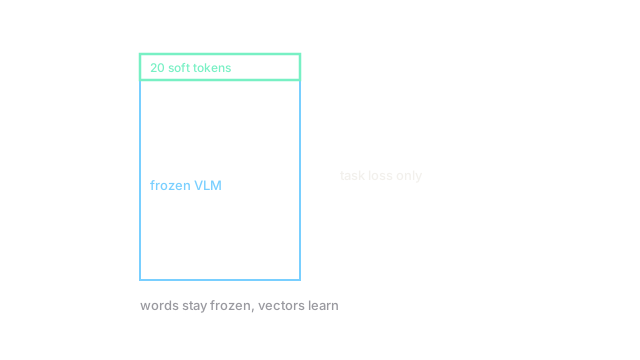
Soft prompt of vectors prepends to inputs into frozen . Only learns by task loss. Init from word embeddings beats random.
Think of It Like This
A custom stamp before a fixed form letter
A office letter stays fixed, but a custom stamp at top routes it to the right desk. Each department cuts its own stamp and shares the letter stock.
Frozen model is the letter, soft tokens are stamps, and training cuts the shape. Where it stops: stamps cannot rewrite paragraphs, so hard shifts need more.
How It Actually Works
Freeze VLM . Init vectors from class words. Prepend to text inputs, forward, and train on task loss for many steps. Sweep length to and learning rate high, since only moves.
In plain words: vectors, long schedule, and word init matter most.
Worked example
Pets set: hand prompt percent, tuned tokens , gain after steps. Random init trails word init points at same steps. Length beats by points here.
Watch Out For
Short schedules judging soft prompts weak
Few hundred steps leave vectors raw and scores lag hand prompts. Work looks failed early. Train thousands of steps with a strong schedule before comparing to adapters or full tunes.
The Quick Version
- Prompt tuning learns 20 vectors before frozen inputs.
- No backbone weights move per task.
- Word init beats random starts.
- Long schedules are required.
- Kilobytes per task versus megabytes.