ADE20K Scene Parsing Data
Diverse indoor and outdoor scenes with dense labels for hundreds of thing and stuff classes, built for full scene parsing.
Why Does This Exist?
Street sets cover roads well and little else. Bedrooms, kitchens, offices and skies need labels too, including background stuff like wall and floor alongside countable things. ADE20K gathered varied scenes with dense labels across a broad vocabulary, so scene parsing could be tested beyond streets.
This page covers purpose, dense I/O roles and appropriate use. Pyramid pooling context is in PSPNet.
Think of It Like This
Labeling every surface in a lived-in room
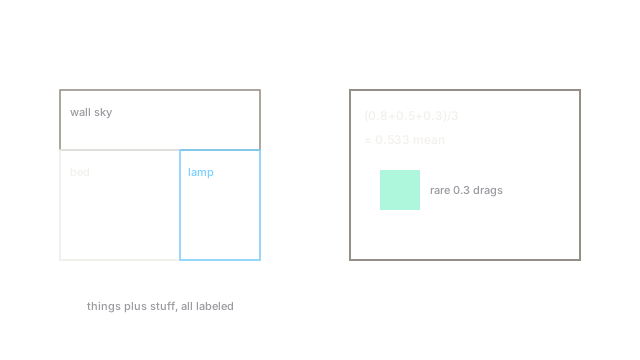
Walk into a bedroom and name every surface: wall, floor, bed, lamp, window, sky outside. Some items count, some are just background, but all need a name.
That full-room inventory is ADE20K. Streets are one room among many here.
How It Actually Works
Purpose is dense scene parsing over a broad vocabulary. Input is one varied photo, output is one label per pixel across thing and stuff classes. Appropriate use is testing large-vocabulary segmenters and context modules. Rare classes dominate the difficulty, so mean IoU moves slowly while frequent classes look strong.
Toy mean walkthrough
Take three classes with IoUs 0.8, 0.5 and 0.3. Mean IoU is . One rare class at 0.3 drags the headline down, which is the honest signal on broad vocabularies.
Code
Mean over per-class ratios, the headline behind broad parsing.
import numpy as np
def mean_iou(scores: np.ndarray) -> float: return float(scores.mean()) # equal vote per class, rare or not
print(f"{mean_iou(np.array([0.8, 0.5, 0.3])):.3f}")# -> 0.533Three ratios average to 0.533, with the rare class fully visible.
Watch Out For
Reading frequent-class strength as full parsing
Walls and floors score high and hide weak rare objects. The symptom is a decent mean with useless small-item masks. Fix it by reporting tail-class IoU separately and sampling rare classes harder in training.
The Quick Version
- ADE20K maps one varied scene to dense labels across a broad thing and stuff vocabulary.
- Input is a photo, output is a per-pixel map over hundreds of classes.
- Toy 0.8, 0.5 and 0.3 average to about 0.533 mean IoU.
- Use it to test large-vocabulary parsing and context use.
- Watch tail classes, because frequent surfaces hide them.