Age and Gender From Faces
Age and gender models read facial texture and shape together, predicting a likely range instead of one exact birthday.
Why Does This Exist?
Retail analytics, accessibility, and photo organization need rough demographics without ID checks. Exact birthdays are unknowable from pixels, but ranges guide real decisions.
Joint models learn both traits at once. They start from face detection and recognition, share cues with facial expression recognition, and verify identity separately with face verification.
Think of It Like This
Guessing ages at a family reunion
You guess cousins by hair, skin, and posture together, giving ranges like mid-thirties rather than exact years.
It fails in dim halls on unfamiliar families. Bad light ages everyone and unknown traits skew guesses, just as biased data skews models.
How It Actually Works
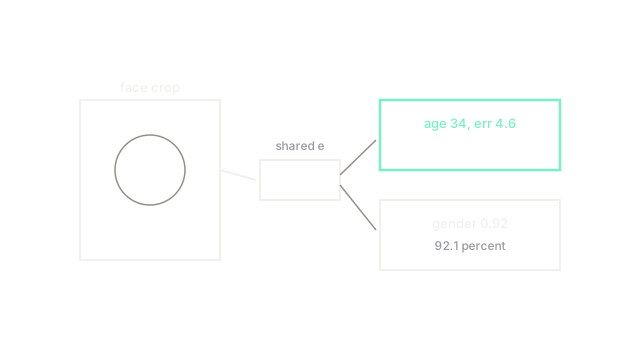
Let be a face crop and its embedding, where is the shared backbone. Age is regression in years, where maps features to age. Gender is , where is sigmoid and near 1 means one class. Train both heads together.
Worked example
A crop predicts against apparent truth 32, so absolute error is years. Dataset mean error is 4.6 years. Gender gives above 0.5 and calls correctly. Lighting shift adds 3 years bias on dark images, showing why error bars matter more than point guesses.
Watch Out For
Shipping apparent age as exact age
Apparent labels carry rater bias across groups. The symptom is larger errors on underrepresented ages. Report ranges with mean error and audit per-group gaps before any gating use.
The Quick Version
- One embedding feeds age regression and gender sigmoid .
- Fixture predicts 34 years at error 2 with gender 0.92 correct.
- Dataset means are 4.6 years error with 92.1 percent gender accuracy.
- Lighting and skew shift groups unevenly, so audit gaps.
- Predict ranges with uncertainty, never exact birthdays.