Facial Expression Recognition
Expression recognition reads emotions from faces by mapping muscle movements to labels like happy or angry, knowing culture and context can fool it.
Why Does This Exist?
Drivers fall asleep, students disengage, customers frown: faces broadcast states that surveys catch too late. Expression recognition exists to read those broadcasts at scale from ordinary cameras, classifying aligned crops into basic emotions (happy, sad, angry, fearful, surprised, disgusted, neutral) or continuous valence-arousal scores. Faces come from face detection and recognition pipelines; the labels come from acted and in-the-wild datasets with all their biases.
Think of It Like This
Reading a poker table through frosted glass
You watch blurred players and call moods from brow angles and mouth curves, right on caricature grins and lost on polite half-smiles. Acted datasets are the caricatures: peak expressions held for the camera. The wild is the frosted glass: subtle, blended, culturally shaded. Models trained on the table of actors confidently misread the table of strangers. The analogy stops at the fix: humans ask for context, while models need valence-arousal training and temporal smoothing to stop committing to single frames.
How It Actually Works
Aligned face crops feed a classifier (often an image backbone fine-tuned from face recognition weights) outputting emotion logits or valence-arousal values. Label smoothing and class balancing fight the dominance of happy and neutral samples. Video versions aggregate per-frame scores with temporal models, since expressions onset, peak and offset over seconds. Facial action units (brow raise, lip tighten) serve as interpretable intermediate labels in serious systems.
A worked smoothing
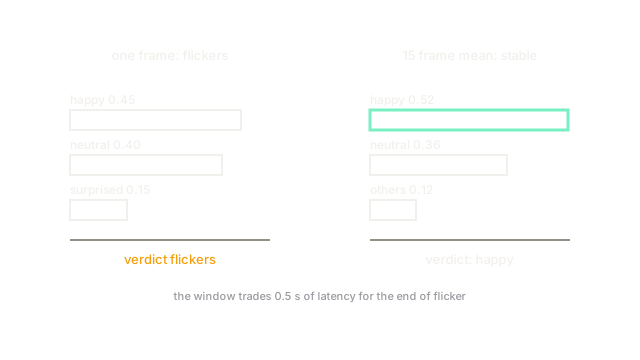
Single frames of a polite smile score happy at 0.45, neutral 0.40, surprised 0.15, flickering across frames. Averaging logits over a 15-frame window gives happy 0.52, neutral 0.36, others 0.12: the verdict stabilizes on happy without ever trusting one frame's 0.45. The window trades 0.5 seconds of latency for the end of flicker, which every deployment gladly pays.
Watch Out For
Acted data that flatters and fails
Models scoring 90 percent on posed datasets drop toward 60 on spontaneous faces because acted peaks exaggerate every muscle. The symptom is a demo that nails volunteers and misreads customers. Fix it by validating on in-the-wild spontaneous sets and by reporting per-emotion rates instead of one mean.
The Quick Version
- Classify aligned crops into basic emotions or valence-arousal scores.
- Start from face-recognition weights; expressions need the same face priors.
- Smooth over time: single frames flicker, windows stabilize.
- Action units give interpretable middles between pixels and emotions.
- Validate on spontaneous data or acted accuracy will deceive you.