Animal Pose Across Species
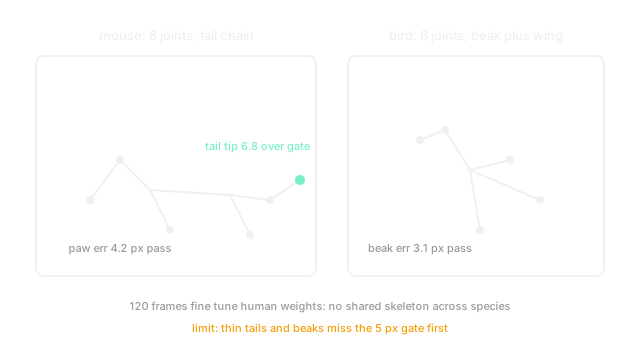
Animal pose adapts keypoint tracking to fur, feathers, and new skeletons, trading human data scale for species-aware models and few-shot transfer.
Why Does This Exist?
Human 2D pose enjoys COCO scale and one shared skeleton, but a mouse, a horse, and a fly share neither joints nor fur texture. Behaviour labs need paw reaches, tail flicks, and pecking strikes from a few hundred labelled frames, not millions. Tools like DeepLabCut (Mathis et al., 2018) and SLEAP (Pereira et al., 2022) fine-tune human-pretrained backbones on to frames per animal, then track socially housed groups with bottom-up or top-down assignment.
Think of It Like This
Tailoring one pattern to many breeds
A tailor owns a human jacket pattern and alters it per breed: shorten sleeves to paws, add a tail vent, move darts to withers. A few fittings per breed beat drafting from scratch. Species transfer works the same: human-pretrained features plus a few labelled frames per species.
Where it stops: a fly's wing hinge has no jacket equivalent, and the pattern needs fresh drafting.
How It Actually Works
Annotators label snout, ears, paws, tail base, and tail tip (quadruped example) on diverse frames picked by k-means over motion. A ResNet or HRNet backbone with deconvolution heads trains with augmentation heavy on rotation and scale, since animals circle cameras. Multi-animal setups add part-grouping or identity tracking across frames. AP-10K benchmarks cross-species generalization over dozens of families. Temporal median filtering and speed gating clean trajectories before behaviour classifiers read reaching, grooming, and chase motifs.
Worked example
Two hundred labelled frames train a mouse-reach tracker. Nose error pixels on a -pixel frame with body length pixels: percent of body length, inside the usable band. Paw speed gating at pixels per frame removes identity swaps when two mice cross: jumps above that are flagged as swaps, not sprints.
Code
# Error as a fraction of body length.print(round(4 / 150 * 100, 1))# -> 2.7Watch Out For
Borrowing the human skeleton verbatim
Forcing seventeen human joints onto a horse maps withers to shoulders badly. Symptom: permanently high error on species-specific parts. Fix: define joints from anatomy first (hooves, hocks, withers), then map only shared concepts.
Identity swaps in group housing
Same-fur cage mates swap IDs at crossings. Symptom: behaviour motifs split across animals. Fix: track with appearance plus motion, verify swap rate on crossing clips, and keep single-animal baselines for calibration.
The Quick Version
- Skeletons are species-specific: paws, tails, beaks replace human joints.
- Fifty to two hundred diverse frames can train a lab-grade tracker.
- Human-pretrained backbones transfer; the head must be redefined.
- Group housing needs identity-aware grouping and swap auditing.
- AP-10K measures cross-species generalization across families.