Blob Detection
Blob detectors look for compact round regions at their own best scale, so a cell or coin is found with both a center and a size.
Why Does This Exist?
Corners mark junctions, but many targets are compact lumps: cells, coins, berries, traffic signs. A corner detector fires on their boundary clutter instead of their centers. Blob detection fills that gap by returning a center plus a radius.
It also introduces scale selection. A small kernel loves small blobs and a large kernel loves large blobs, so scanning kernels across scales tells you both where the blob sits and how large it is. For edges and lines first, see spatial filtering and edge detection.
Think of It Like This
Pressing sieves into dough
Press small and large round cutters into rolled dough. A pea fits the small cutter best, an apple slice fits the large one. The cutter that hugs the edge without much slack names the size.
Blob filters work the same way. Each scale is one cutter. The scale with the strongest response names the blob radius. The analogy stops at shape: cutters assume circles, while real blobs can stretch into ellipses.
How It Actually Works
The Laplacian of Gaussian, LoG, smooths with Gaussian width then takes the second derivative . Normalized response is compared across scales, and local maxima in space become blobs with radius .
Worked numbers
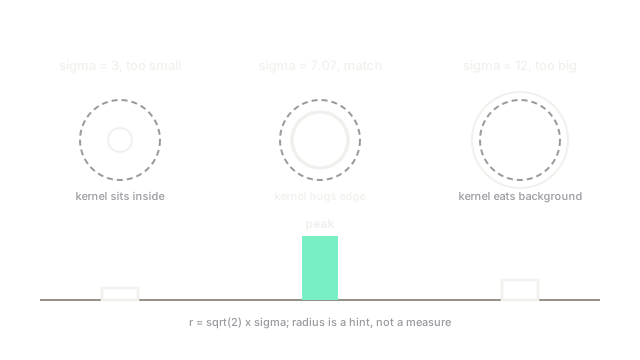
A bright disk of radius pixels gives peak LoG response near . At , the kernel sits inside the disk and response is weak. At , the kernel covers background and response drops. The detector reports center plus from the peak.
Common variants trade cost for shape handling. Determinant of Hessian suits textured blobs, Difference of Gaussians approximates LoG cheaply, and MSER extracts stable connected regions instead of filter peaks.
Watch Out For
Dense texture becomes blob soup
Gravel, foliage, and fabric give thousands of tiny maxima. You get centers everywhere and signal nowhere. Smooth first, raise the response floor, or switch to a region method with size limits.
Reading radius as exact size
The rule assumes a clean disk. Elongated or overlapping blobs report a compromise radius. Treat it as a scale hint for matching, not a measurement for metrology.
The Quick Version
- Blob detectors return centers plus radii, not just corner points.
- LoG across scales finds the kernel size with peak response.
- Radius follows for ideal disks.
- DoG, Hessian determinant, and MSER trade speed and shape handling.
- Great for cells, coins, and signs at unknown sizes.