CenterPoint 3D Detection by Centers
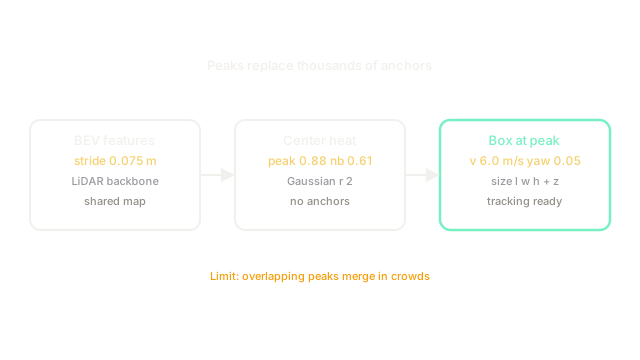
CenterPoint finds 3D objects by predicting their centers on a bird's-eye map instead of placing thousands of anchors.
Why Does This Exist?
Anchor-based LiDAR detectors tile every position with several pre-sized boxes and then classify each one. Most anchors are empty, and small size errors hurt. Anchor boxes work in 2D but in 3D the anchor count explodes across yaw and height. Tracking then needs a second association step.
CenterPoint (2021) drops anchors entirely. It predicts a heatmap of object centers on the bird's-eye view and regresses size, height, and yaw only at the peaks. The same centers feed velocity regression, so detection and tracking share one representation. This page covers the center head. The voxel backbone underneath can be a SECOND-style encoder.
Think of It Like This
Finding tents by their campfires at night
From a hilltop you cannot see tent outlines in the dark, but each tent has one campfire. You mark every flame on your map, walk to each flame, and then measure the tent around it. No flame, no tent.
Centers are campfires and boxes are tents. The heatmap marks flames, and regression measures the tent. The analogy stops at motion: campfires do not carry velocity, but CenterPoint peaks do.
How It Actually Works
The bird's-eye feature map has stride m per cell. Ground-truth centers are splatted into a heatmap with a Gaussian of radius cells. The network predicts plus box attributes at each cell: offset , height , size , yaw , and velocity .
Worked example
A car center at m maps to cell since and . The target heat at the peak cell is , at one cell away . The model predicts peak with offset cells, which corrects to m, size m, yaw rad, velocity m/s. A m center error keeps IoU above .
Watch Out For
Heatmap threshold hiding distant pedestrians
A fixed peak threshold of keeps cars but deletes a pedestrian peak at past m. The symptom is recall that falls with range. Lower the threshold to for small classes and let the box scorer filter.
Yaw flip on symmetric cars
Predicting directly flips a car by because front and back look alike. The fix is the and pair, which makes and far apart in target space.
The Quick Version
- CenterPoint predicts center heat peaks instead of scoring anchor boxes.
- Size, yaw, height, and velocity are read only at the peaks.
- One representation serves detection and tracking together.
- Do not use it when objects overlap heavily in bird's-eye view; peaks merge.
- Gaussian radius cells balances localization against missed small objects.