Curriculum Learning for Vision Models
Show the model easy images first and hard ones later, so early steps build stable features instead of chasing noise.
Why Does This Exist?
Random shuffling feeds a fresh network its hardest images on step one: tiny occluded objects, heavy blur, rare poses. Early gradients are large and noisy, so the model burns capacity fitting label noise before its features exist. Curriculum learning orders training from easy to hard, letting stable edges and shapes form before ambiguous cases arrive.
It is a scheduling choice, not new data: the same images in a planned order. It pairs with image augmentation, whose strength can follow the same schedule, and with transfer learning, which changes what counts as easy. The failure it prevents resembles catastrophic forgetting in miniature: early noise overwriting nothing yet learned.
Think of It Like This
Teaching reading with graded books
Children read short clear sentences before dense novels, and the same pages in reverse order would frustrate them into guessing. Easy images are large centered objects in clean light; hard images are occluded, tiny, or cluttered. The analogy stops at the scorer: book levels are fixed by editors, while image difficulty must be estimated by the model itself and changes as it learns.
How It Actually Works
Score every image by difficulty, then schedule. Common scorers are image clarity heuristics, loss under a reference model, or the current model's own loss, which gives self-paced variants that promote examples as they become solvable. A pacing function sets what fraction of ranked data is available at each epoch, growing from the easiest slice to the full set.
Worked example with recomputed numbers
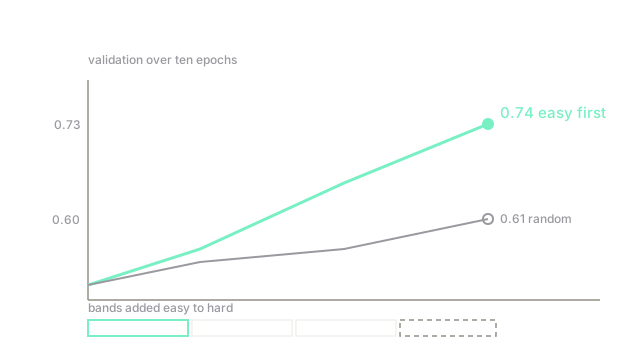
Rank 10,000 training images by reference-model loss into five bands of 2,000. Train band one alone for two epochs, then add one band every two epochs. After ten epochs validation reads 0.74. The random-order control at the same step count reads 0.61, a gap of 0.13 from ordering alone. Continue both to fifty epochs and the gap shrinks to 0.02, which states the honest scope: curriculum buys speed and stability, not a higher ceiling.
Difficulty scoring is the method
Fixed heuristics are cheap and blind to the model. Reference-model loss tracks human difficulty better and costs one extra training run. Self-paced scoring adapts but can collapse to only easy images when the pacing weight is wrong, so cap the easy fraction and force the full set by the final third of training.
Watch Out For
A curriculum that never graduates
A gentle schedule that holds back hard images past mid-training leaves the model untested on the tail it will meet in production. The symptom is sparkling validation on easy slices and failure on occluded inputs. Force full data by the final third and validate per difficulty band, not just the mean.
The Quick Version
- Order images easy to hard so early gradients build features instead of fitting noise.
- The worked schedule gains 0.13 early, 0.74 against 0.61 at ten epochs.
- Gains fade with long training, so curriculum is acceleration, not capacity.
- Score difficulty by reference loss or self-paced loss, never vibes.
- Graduate to the full set on time and report accuracy per difficulty band.