DBNet Binarizes Text Cleanly
DBNet learns its own threshold map for turning soft text heat into crisp polygons, so faint letters survive without flooding the page.
Why Does This Exist?
Fixed cutoffs force a bad trade. Low thresholds flood pages with noise, high thresholds erase faint receipts. One number cannot fit every pixel.
DBNet predicts the threshold itself per pixel and binarizes differentiably. It refines text detection, passes polygons to text recognition, and cleans the handoff into optical character recognition.
Think of It Like This
A flood line drawn per street
A town draws flood walls per street height instead of one city wall. Low streets get higher walls, high streets get lower ones.
It fails when the survey is wrong. Bad local walls flood some streets while walling off dry ones, just as bad thresholds keep noise and drop ink.
How It Actually Works
Predict probability and threshold per pixel, where is text heat and is the local cutoff. The binary map is with sharpness , where large nears a hard step but stays differentiable. Pixels with survive.
Worked example
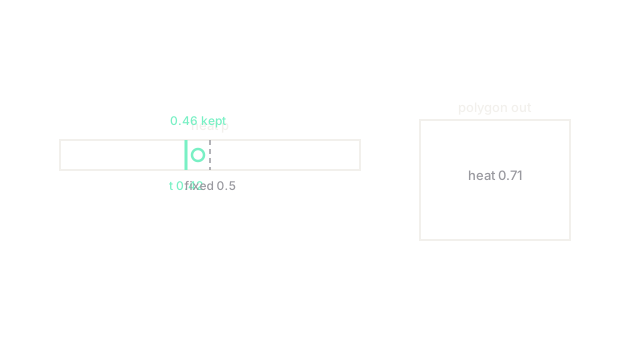
A faint stroke has with learned . Since , , so it survives. A fixed 0.5 cutoff deletes it because . A noise pixel with and gives and stays out.
Watch Out For
Letting thresholds collapse to zero
Without supervision the map drifts down and everything passes. The symptom is full-page blobs. Supervise inside text borders and clip it to a sane band such as 0.2 to 0.7.
The Quick Version
- DBNet predicts heat plus local threshold per pixel.
- Binarization with stays differentiable for training.
- Fixture heat 0.71 over threshold 0.42 survives while fixed 0.5 erases faint ink.
- Adaptive cutoffs fit receipts, signs, and dense lines together.
- Supervise and clip or the map floods.