Dice Loss for Segmentation
Dice loss scores the overlap between prediction and truth instead of counting pixels, so a tiny tumour still shouts loudly against a huge background.
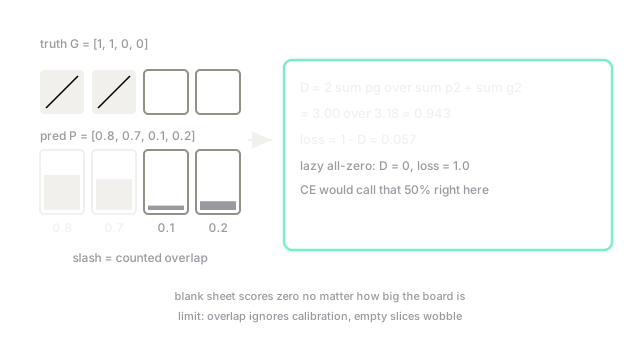
Why Does This Exist?
Per-pixel cross-entropy counts every pixel equally, so a scan that is percent background lets the model score percent by predicting empty masks. Practitioners hit this in U-Net tumour work and in every small-lesion task: the loss looks great and the masks are blank. Dice loss (V-Net, Milletari et al., 2016) scores overlap and minimizes one minus that, so missing a -pixel lesion hurts as much as missing a -pixel organ.
This page is the overlap-loss base of the wave. Focal reweights hard pixels, Tversky splits false-positive and false-negative costs, and Lovasz optimizes IoU directly. General loss background lives in core ML and is out of scope here.
Think of It Like This
Grading tracings by overlap, not by paper
A teacher grading tracings of a coin on a poster board could count every matching square inch of board, which rewards leaving the sheet blank. Dice grading lays the tracing over the coin print and scores shared area against total inked area. A blank sheet scores zero no matter how big the board is.
Where it stops: overlap alone ignores calibration, so a model can be right-shaped but overconfident.
How It Actually Works
For predicted probabilities and binary truth over pixels, with smoothing :
Squares in the denominator (the V-Net form) downweight uncertain mid-range scores. Gradients flow through the intersection term, so shrinking a true region raises the loss even when the background is vast.
Worked example
Truth , prediction . Numerator . Denominator . , loss . A lazy all-zero prediction gives , loss , while cross-entropy would call it percent accurate here and percent on real scans.
Code
# Soft Dice on the worked example.p = [0.8, 0.7, 0.1, 0.2]g = [1.0, 1.0, 0.0, 0.0]num = 2 * sum(pi * gi for pi, gi in zip(p, g))den = sum(pi * pi for pi in p) + sum(gi * gi for gi in g)print(round(1 - num / den, 4))# -> 0.0566Watch Out For
Division wobble on empty slices
Slices with no foreground make the denominator tiny and gradients explode between batches. Symptom: loss spikes on background-only crops. Fix: keep , include foreground-bearing crops in every batch, or add a small cross-entropy term.
Using Dice alone for multi-class maps
Binary Dice per class ignores mutual exclusion. Symptom: overlapping class scores that sum past one. Fix: average per-class Dice with a softmax head, or pair Dice with cross-entropy.
The Quick Version
- Dice loss is one minus the soft overlap .
- Tiny foregrounds keep full gradient voice regardless of background size.
- Blank predictions score the worst possible , not percent accuracy.
- Needs smoothing and foreground-bearing batches for stability.
- Pair with cross-entropy for multi-class or calibration-sensitive tasks.