Lovasz-Softmax Loss
Lovasz-Softmax is a smooth stand-in for IoU itself, so training optimizes the contest score instead of a pixel-counting proxy.
Why Does This Exist?
Models are ranked by mean IoU but trained on cross-entropy, and the two disagree: shaving background log-loss can lower the loss while IoU stalls. The Lovasz-Softmax loss (Berman et al., 2018) closes the gap with a convex, differentiable extension of the discrete Jaccard index. Instead of counting pixels, it sorts each class's pixel errors from worst to best and weights them by how much each rank position affects IoU.
Use it as a fine-tuning stage over a cross-entropy warm start. For the overlap basics see Dice; for asymmetric recall see Tversky.
Think of It Like This
Fixing a parade lineup by worst offender first
A parade judge scores the whole formation, not each marcher. The Lovasz coach lines up mistakes from most formation-breaking to least: the marcher facing backwards is fixed before the one half a step off. Cross-entropy coaches every marcher equally. The sorted lineup spends effort where the formation score moves.
Where it stops: sorting needs a full ordered list per class, so tiny batches give noisy orders.
How It Actually Works
For one class, define the error vector on pixels where the class applies, sort descending, and accumulate the Lovasz extension as a weighted sum where weights are marginal IoU drops between successive thresholds. The multiclass loss averages this over classes present in the batch. In practice implementations flatten per-class errors, sort with argsort, compute the Jaccard gradient steps in closed form, and dot them with the sorted errors. No sampling or threshold tuning is needed.
Worked example
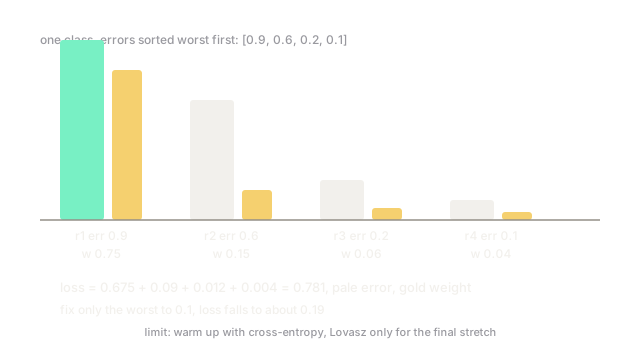
One class, four pixels, errors sorted with one true foreground pixel. The Lovasz weights for ranks to on this toy are approximately : the worst error carries most of the IoU damage. Loss . Fixing only the worst pixel to drops the loss to about , while fixing only the best pixel barely moves it. Cross-entropy would price all four fixes equally.
Code
# Toy Lovasz-style weighting: worst errors dominate.errors = [0.9, 0.6, 0.2, 0.1]weights = [0.75, 0.15, 0.06, 0.04]print(round(sum(e * w for e, w in zip(errors, weights)), 3))# -> 0.781Watch Out For
Starting from scratch with Lovasz only
Cold-start Lovasz is noisy before scores separate. Symptom: mIoU oscillates early and never recovers. Fix: warm up with cross-entropy for most of training, then fine-tune with Lovasz-Softmax for the final stretch.
Averaging over absent classes
Classes missing from a crop still enter some naive averages as perfect scores, biasing the mean. Symptom: inflated validation loss drops that vanish on full images. Fix: average only over classes present in the batch, the standard implementation behaviour.
The Quick Version
- Lovasz-Softmax is a smooth extension of IoU, not a pixel counter.
- Per-class errors are sorted worst-first and weighted by marginal IoU damage.
- Training optimizes the evaluation metric directly during fine-tuning.
- Warm-start with cross-entropy; use Lovasz to finish.
- Average only over classes present in each batch.