Eye Tracking
Eye tracking finds where you look by watching pupils and glints, turning eye photos into gaze points for foveated display and attention study.
Why Does This Exist?
Heads point coarsely while eyes point precisely. Foveated displays, attention research, and hands free selection need the precise point. Head pose alone misses by many degrees.
Eye tracking exists for gaze. Input is eye images with infrared glints. Output is a gaze point plus confidence. The headset home is AR and VR; geometry is camera calibration. Eye crops build on object detection.
Use it when looks select, steer rendering, or measure attention. Use head pointing when glasses, sun, or consent rule out eye cameras.
Think of It Like This
A flashlight dot on a wall map
A friend shines a laser on a wall map while you watch their hand angle. Pupil center is the hand, the corneal glint is a fixed wall stud that anchors the angle math.
Calibration is marking which hand angles hit which cities. The analogy stops at drift: hands hold still while eyes saccade times per second, so filtering must separate fixations from flights.
How It Actually Works
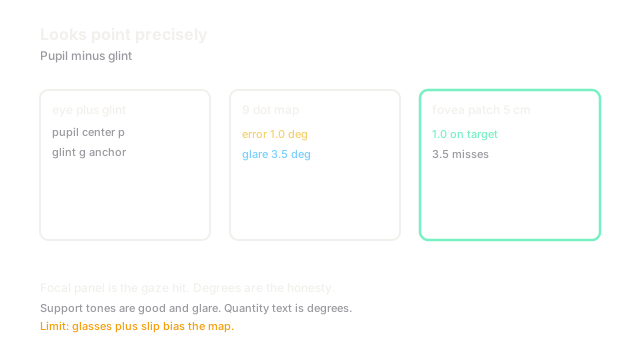
Light the eye with infrared, find pupil center and glint , then map vector to screen with a calibrated polynomial. Contract is eye crop in, gaze point plus confidence out. Calibrate on dots to fit the map; validate error in degrees. A degree error at cm viewing shifts gaze by about cm, inside a fovea patch of cm. A degree error shifts cm and drops the sharp patch off target.
Worked example
Nine dot calibration gives mean error degrees. A menu button spans cm at cm, about degrees wide. Gaze at button center lands degrees off, still inside. With glasses glare error rises to degrees and the point lands outside, so dwell selection times out. The fix is glare masks plus a point recalibration, which returns error to degrees.
Watch Out For
Glasses and sun that eat the glint
Coatings reflect the illuminator into blobs while sunlight floods the sensor. The symptom is confidence collapse outdoors. Fix it with narrowband infrared plus hoods, and fall back to head pointing when confidence stays low.
Calibration drift sold as truth
Headset slip of mm moves the eye camera and biases all gaze by degrees. The symptom is systematic offsets after an hour. Fix it with slip detection and quick single dot touch ups during use.
The Quick Version
- Eye tracking maps pupil minus glint vectors to gaze points.
- Nine dot calibration plus degree error reporting make results honest.
- The fixture holds degree on target against degree misses.
- Foveated rendering and dwell select need confidence, not just points.
- Glasses, sun, and slip are the first failures to handle.