GMFlow Transformer Flow Matching
Match every pixel to every pixel with attention, then read flow from the match. GMFlow swaps pyramids for one global transformer match.
Why Does This Exist?
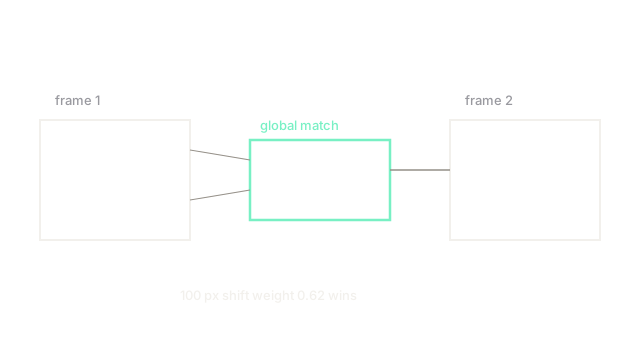
Local windows in PWC-Net and iteration in RAFT still start from limited neighborhoods. GMFlow exists to match globally first: transformer self- and cross-attention enrich both frames, then a softmax over all pairs gives each pixel a distribution over matches. Large displacements become direct lookups instead of coarse-to-fine hunts.
Recurrent refinement remains RAFT; the first learned baseline is FlowNet.
Think of It Like This
Matching socks by spreading them all out
Find a sock match by spreading every sock on the bed at once instead of checking drawer by drawer. The pair pops visually because all candidates compete together.
Pixels are socks and softmax is the glance across the bed. The analogy stops at ambiguity: socks differ clearly while flat image patches match everywhere, needing refinement after the global vote.
How It Actually Works
Shared CNN features plus six transformer blocks produce descriptors and . Correlation soft-maxes over frame two into match weights ; flow reads as expected displacement , where is the pixel grid. A small RAFT-style head refines the result for subpixel detail and occlusions. Bidirectional matching plus cycle consistency flags occluded pixels whose forward and backward matches disagree.
Worked numbers
A px jump is outside any window yet lands in the top softmax bin with weight against runner-up. Final Sintel clean error sits near px with one refinement pass versus px for twelve RAFT steps, trading a little accuracy for fewer iterations.
Code
def expected_flow(weights: list[float], positions: list[float], grid: float) -> float: return sum(w * p for w, p in zip(weights, positions)) - grid # softmax expectation
print(expected_flow([0.62, 0.03, 0.35], [100.0, 10.0, 95.0], 0.0)) # -> 95.55Watch Out For
Trusting softmax peaks on blank regions
Flat patches give diffuse match distributions where the argmax is noise. The symptom is confident flow on walls and sky. Check distribution entropy and down-weight high-entropy pixels before refinement.
The Quick Version
- GMFlow matches all pixel pairs with transformer attention first.
- Softmax over matches turns correspondence into expected flow.
- Global matching captures px shifts directly.
- A light head refines subpixel detail and occlusions.
- Error near px on Sintel clean with few iterations.
- Diffuse match distributions mark unreliable regions to gate.