Handwriting Reads Cursive Strokes
Handwriting models read whole stroke sequences without cutting letters first, so cursive joins and slants stay intact.
Why Does This Exist?
Print OCR expects separated glyphs. Cursive joins letters, slants vary by writer, and ink fades unevenly, so character cutting fails before recognition starts.
Handwriting reads sequences. It specializes optical character recognition, shares sequence decoding with text recognition, and modernizes into models like TrOCR.
Think of It Like This
Reading a signature without lifting the pen
You read a signed name by following one continuous pen trail and guessing word breaks, not by cutting apart letters that were never separate.
It fails on a new flourish you never learned. One unseen loop style turns a known name into guesswork, just as unseen writers spike error.
How It Actually Works
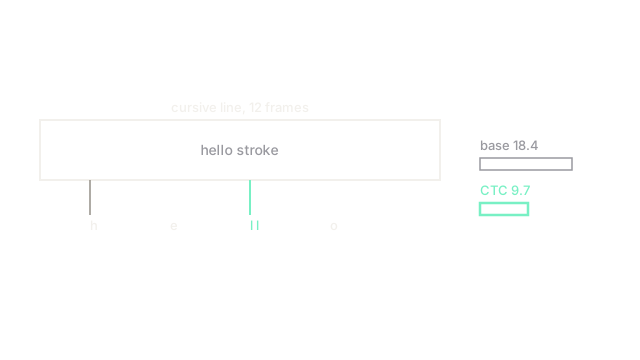
Slice a line into thin frames, where counts horizontal steps. Predict per-frame letter scores, then CTC sums over all alignments that collapse repeats and blanks into the target word. For truth "hello" with 5 letters, alignments like "hh-ell-lo" all count, where "-" is blank.
Worked example
Baseline template matching gives word error 18.4 percent on IAM lines. CTC training on the same lines reaches 9.7 percent, a drop of 8.7 points. The 12 frames align to 5 letters with blanks absorbing joins, so no cutter runs. Rare surnames still miss without a lexicon because the language prior never saw them.
Watch Out For
Testing on the same writers as training
Writer overlap inflates scores because slant and loops repeat. The symptom is 9 percent in lab and 20 percent on new forms. Split IAM by writer, not by line, to measure honestly.
The Quick Version
- Lines become frames scored per letter, then CTC aligns to words.
- Fixture error falls 18.4 to 9.7 percent without any character cutter.
- Blanks absorb cursive joins and repeats collapse cleanly.
- Writer-independent splits are the honest test for deployment.
- Rare names still need lexicon help beyond pixels.