Imagen
Imagen pairs a frozen large language model with cascaded diffusion, betting that deeper text understanding beats bigger image networks for alignment.
Why Does This Exist?
Text-to-image kept failing the same way: gorgeous scenes ignoring the prompt's fine print. The bottleneck was not painting but reading: shallow text encoders flattened complex descriptions into mush before generation began. Bigger image networks could not recover dropped meaning.
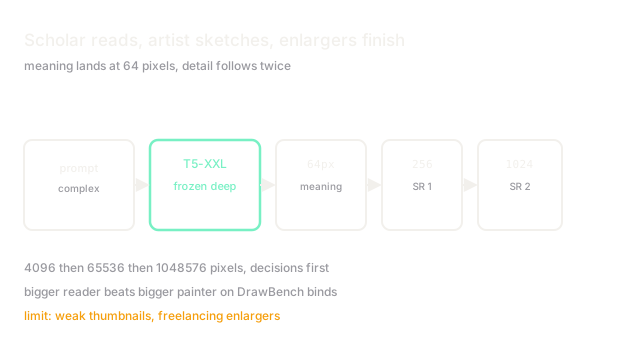
Imagen bet the budget on language. A frozen T5-XXL encoder, trained on text alone, supplies deep understanding; a small -pixel diffusion model draws from it; two super-resolution diffusion stages carry . Alignment jumped because the reader finally matched the brief. The family map is text-to-image and text-to-video, and the cascade's final stages echo super-resolution.
Think of It Like This
A scholar directing a sketch artist by phone
A scholar who read every book describes a scene over the phone to a sketch artist with a small notepad, who draws thumbnails. Two enlargers then blow the sketch to gallery size, adding paper-appropriate detail at each scale without changing the composition.
The scholar is T5, the thumbnail is the -pixel base, enlargers are the super-resolution stages. The chain fails when the scholar mumbles, weak encodings, or when enlargers freelance new content the thumbnail never contained.
How It Actually Works
T5-XXL encodes the prompt once, frozen, into deep contextual embeddings. The base diffusion model conditions on them at , where composition and binding are decided cheaply. Stage two upsamples to conditioned on text plus the small image; stage three reaches the same way. Noise conditioning augmentation, adding noise to the conditioning image during super-resolver training, keeps stages steady against base-model imperfections:
DrawBench, a set of compositional prompts probing counting, colours, and spatial relations, measured the payoff: scaling the language encoder improved alignment more than scaling the diffusion model did, the paper's headline result.
Worked example
Three-stage pixel budgets: base pixels where meaning lands; first super-resolution ; final million. The base decides that the red cube sits left of the blue sphere; later stages only sharpen. Spend compute on T5 depth once per prompt, reuse across all sampling steps, while the heavy pixel stages handle rendering they were built for.
Code
Cascade budget arithmetic, showing where pixels live per stage.
def cascade_pixels() -> tuple[int, int, int]: """Pixel counts across the 64, 256, and 1024 stages.""" return 64 * 64, 256 * 256, 1024 * 1024
print(cascade_pixels()) # -> (4096, 65536, 1048576) meaning first, detail laterWatch Out For
Starving the base stage of capacity
A weak -pixel model bakes composition errors no super-resolver fixes: wrong counts, merged objects. Teams scale the shiny stage while the thumbnail decides everything.
Evaluate alignment at pixels directly. If the small image disobeys the prompt, upscalers only sharpen disobedience.
Super-resolvers inventing unprompted content
Conditioned weakly, upscalers freelance texture and objects to fill pixels: new windows on blank walls, extra birds in skies. The final image outgrows its brief.
Condition every stage on text, not just the base. Audit outputs against prompts, not just thumbnails.
The Quick Version
- Imagen pairs frozen T5-XXL understanding with cascaded diffusion.
- Composition lands at pixels; later stages only add detail.
- Language-encoder scaling beat diffusion scaling for prompt alignment.
- Noise conditioning augmentation keeps super-resolvers steady against base flaws.
- Weak base stages and freelancing upscalers are the two failure points.