Super-Resolution
Super-resolution reconstructs a sharp high-resolution image from a small blurry one by learning what fine detail typically hides behind coarse pixels.
Why Does This Exist?
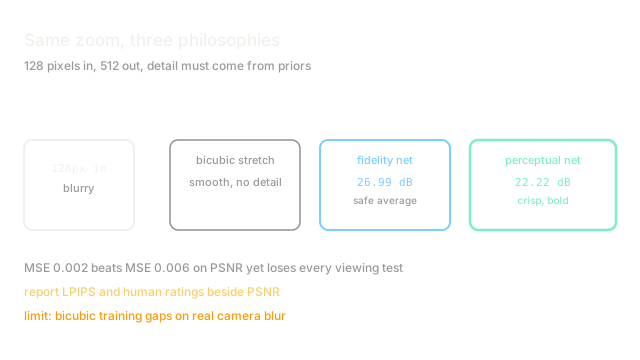
Zooming is not resolving. Bicubic interpolation stretches pixels into smoothly, inventing no eyelashes, no brick lines, no texture, just larger blur. Surveillance, medical imaging, and photo restoration need actual detail, plausible high frequencies consistent with the low-resolution evidence.
Super-resolution learns the prior over details from data: given this blurry patch, sharp patches in the training set looked like these. The task family map is image-to-image tasks, the founding convolutional method is SRCNN, and the perceptual-quality champion is ESRGAN.
Think of It Like This
A restorer filling cracks in a fresco
A fresco restorer sees a damaged angel wing: coarse shape survives, feather barbs are gone. They study intact wings across the chapel and repaint barbs that fit this wing's pose and light, barbs the original surely had, though no record proves each stroke.
The low-resolution image is the damaged wing and the training set is the chapel. Bicubic interpolation is plastering the crack flat. The restorer fails when chapels differ, training priors from faces smeared onto text, which is the domain limit below.
How It Actually Works
The forward model downsamples: , with blur , decimation , and noise . Single-image super-resolution inverts it with learned priors at scale factor , usually or . Two philosophies compete: fidelity methods minimise pixel error (PSNR-oriented), perceptual methods add adversarial and feature losses for sharpness humans prefer despite worse pixels.
Standard scoring uses PSNR and SSIM for structure. The perception-distortion tradeoff is fundamental: the sharpest-looking outputs rarely minimise MSE, because MSE rewards safe averages over bold correct textures.
Worked example
Upscale (). A reconstruction with MSE on pixels gives PSNR dB. A blurrier output at MSE scores dB and looks worse, while a crisp GAN output at MSE scores dB and looks better. The ranking inverts because MSE cannot see sharpness, only averages.
Code
PSNR arithmetic that prices the fidelity-versus-sharpness tradeoff.
import numpy as np
def psnr(mse: float, maxval: float = 1.0) -> float: """Peak signal to noise ratio from mean squared error.""" return 10 * float(np.log10(maxval ** 2 / mse))
print(round(psnr(0.004), 2)) # -> 23.98 dB our sharp exampleprint(round(psnr(0.002), 2)) # -> 26.99 dB blurrier but higherprint(round(psnr(0.006), 2)) # -> 22.22 dB crisp GAN output, lowestWatch Out For
Chasing PSNR into blur
Leaderboards ranked by PSNR alone select the blurriest competitive model, since averaging candidates minimises squared error. Teams ship record numbers that users call waxy.
Report perceptual metrics (LPIPS, DISTS) and human ratings beside PSNR. State which tradeoff point the model targets instead of claiming both crowns.
Training on bicubic downsamples, shipping on real blur
Synthetic from bicubic decimation mismatches camera blur, sensor noise, and compression. Models excel on benchmarks and smear real photos, the classic domain gap.
Train with realistic degradation pipelines or real paired captures. The degradation model matters more than the network past a point.
The Quick Version
- Super-resolution inverts blur plus decimation using learned detail priors.
- Our example at MSE gives PSNR dB.
- Blurrier outputs can outscore crisp ones: versus dB.
- Fidelity and perceptual quality trade off fundamentally; report both.
- Bicubic-trained models gap on real degradations; model the pipeline realistically.