ImageNet Large Classification
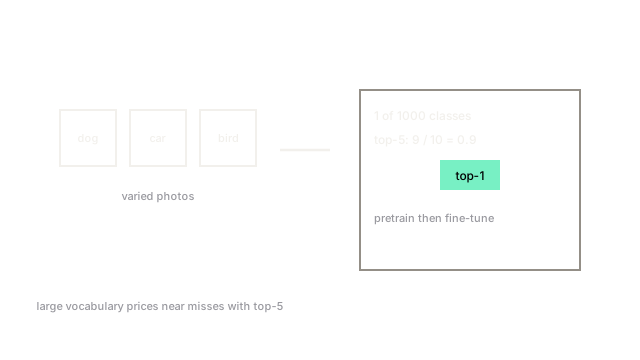
Millions of varied web photos across a thousand classes, the pretraining source that made transfer learning the default.
Why Does This Exist?
Small datasets cannot teach texture, pose and lighting variety. Training only on tiny clean photos leaves models brittle on real pictures. ImageNet gathered varied natural photos across a thousand object classes so a deep network could learn reusable features, then others could reuse those weights for new tasks through transfer learning.
This page covers purpose, I/O contract, split roles and appropriate use. Pretrained weight practice is in pretrained models.
Think of It Like This
A library instead of a flashcard deck
If MNIST is a flashcard deck and CIFAR a pocket album, ImageNet is a library with a thousand shelves. Each book is a photo, each shelf a class, and you learn the building layout once.
Later you walk into a small shop and still find your way, because you already know how libraries organize things. That carryover is pretraining.
How It Actually Works
Purpose is large-scale classification and pretraining. Input is one varied color photo, output is one class among a thousand. Contract is image plus single label, with train, validation and held-out test roles. Appropriate use is pretraining backbones and benchmarking at scale. Say less about exact counts here and check the official source before quoting sizes, because releases and splits are the part that drifts.
Toy top-k walkthrough
Take 10 test photos where the model lists its top 5 guesses each. If the true label sits inside those 5 on 9 photos, top-5 accuracy is even when top-1 is lower. That is why large vocabularies report both: top-1 prices exactness, top-5 prices near misses among a thousand similar classes.
Code
Top-k scoring on a toy batch, the same ratio reported at scale.
import numpy as np
def topk_hit(scores: np.ndarray, true: int, k: int = 5) -> bool: top = np.argsort(scores)[-k:] # largest k scores, order inside does not matter return bool(true in top)
scores = np.array([0.05, 0.60, 0.10, 0.02, 0.03, 0.20])print(topk_hit(scores, 1, k=1), topk_hit(scores, 5, k=2))# -> True FalseClass 1 tops the list so top-1 hits, while class 5 sits third so top-2 misses.
Watch Out For
Treating pretrained features as universal
ImageNet photos skew toward centered, well-lit objects, so features transfer worst to medical, satellite or night imagery. The symptom is a fine-tune that barely beats training from scratch. Fix it by checking domain gap first and budgeting for deeper adaptation on distant domains.
The Quick Version
- ImageNet maps one natural photo to one of a thousand classes for large-scale learning.
- Input is a varied photo, output is a single class label with train, validation and test roles.
- A toy 9 of 10 inside top-5 gives top-5 accuracy.
- Use it to pretrain backbones, then fine-tune for the target task.
- Exact sizes live with the official release, so verify before quoting figures.