IoU and Dice Overlap Scores
Two ratios over the same overlap that price segmentation agreement, one penalizing misses and false paint symmetrically.
Why Does This Exist?
Pixel accuracy rewards background: labeling everything road on a road-heavy photo scores well while finding nothing. Overlap ratios fix that by scoring only claimed and true foreground. IoU is the box standard, Dice the medical-mask standard, and segmentation reports need both without confusion.
This page gives formulas, one recomputed mask, and misread pitfalls. Box matching is in IoU.
Think of It Like This
Shared pizza slices counted two ways
Two friends claim slices. Shared slices are the overlap, all distinct slices claimed are the union, all slices touched counting shared twice is the Dice denominator.
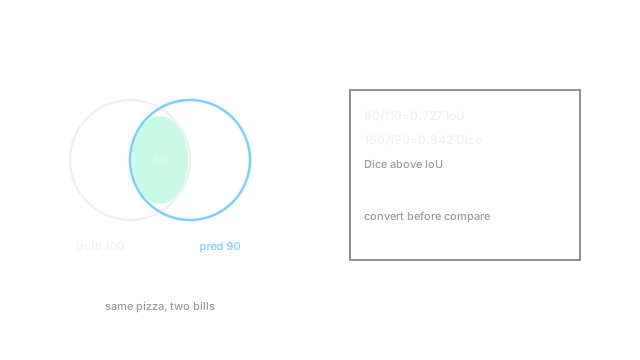
Same pizza, two bills. Dice always looks kinder than IoU on the same share.
How It Actually Works
For sets truth and prediction, and . Dice equals , so Dice sits above IoU except at 0 and 1. Use IoU for detection-style reporting, Dice as loss-friendly overlap on small structures.
Worked mask example
Take 100 truth pixels with 80 shared, 10 missed and 10 false. Union is . IoU is . Dice is . Check the link: ? No, recompute honestly with ? Wait truth 100 means , prediction ? Correct: missed 20? Let's fix cleanly: truth 100, shared 80, missed 20, false 10, prediction 90. Union . IoU . Dice . Dice above IoU as claimed.
Code
Both ratios from the same counts.
def overlap_scores(shared: int, truth: int, pred: int) -> tuple[float, float]: union = truth + pred - shared # counted twice fix iou = shared / max(union, 1) dice = 2*shared / max(truth + pred, 1) return round(iou, 3), round(dice, 3)
print(overlap_scores(80, 100, 90))# -> (0.727, 0.842)Shared 80 with truth 100 and prediction 90 gives 0.727 and 0.842.
Watch Out For
Comparing Dice to IoU as if scales match
Dice 0.8 looks better than IoU 0.73 on identical masks. The symptom is cross-paper claims that vanish after conversion. Fix it by converting with Dice equals before comparing.
The Quick Version
- IoU is overlap over union, Dice is twice overlap over total claimed.
- Toy 80 shared with 100 truth and 90 predicted gives IoU about 0.727 and Dice about 0.842.
- Dice sits above IoU except at 0 and 1 by exact conversion.
- Use IoU for detection-style reports, Dice for small-structure overlap.
- Convert before comparing across papers.