MixMatch Learning
MixMatch guesses labels by averaging several augmentations, sharpens them, then trains on blends of labeled and unlabeled images.
Why Does This Exist?
Single guesses on single views are noisy, and training on them raw amplifies the noise. Teams either threshold hard and waste most unlabeled data or accept soft labels that stay flat and teach little.
MixMatch squeezes more signal from every unlabeled image. It averages predictions over several augmentations, sharpens the average to cut entropy, then blends labeled and unlabeled examples with MixUp so the model trains on smooth interpolations. The umbrella is semi-supervised learning, the threshold cousin is FixMatch, and the task is usually image classification.
Think of It Like This
Blending two paint sketches
An art student sketches the same apple twice from angles, overlays the sketches for an average outline, then traces it bolder to commit. Finally they blend that apple sketch with a pear sketch in graded mixes to practice transitions.
Averaging is the overlay, sharpening is the bolder trace, and MixUp is the graded blend. The analogy stops at targets: paint mixes stay paint, while label mixes are training fictions that only work as regularisation.
How It Actually Works
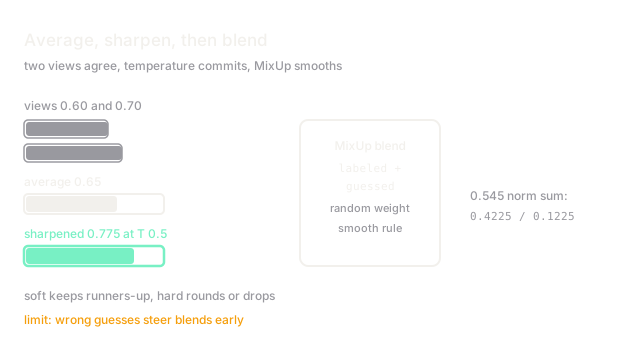
For each unlabeled image, run weak augmentations through the model and average the predicted distributions. Sharpen with temperature :
In plain words: raise each probability to and renormalise. Values below for push mass toward the leader. Then MixUp blends labeled and unlabeled images plus their labels or guessed labels with a random mix weight, and the model trains on the blends with cross-entropy plus squared error terms.
Worked example
Two views predict and , averaging to . Sharpen at by squaring: , , summing to . Normalised guesses become . Entropy falls while the runner-up still contributes, unlike hard thresholding which would round to or drop the image.
Code
Average then sharpen, the label-guessing core.
def sharpen(probs: list[float], temp: float = 0.5) -> list[float]: """Temperature sharpening; temp below 1 pushes mass to the leader.""" powered = [p ** (1.0 / temp) for p in probs] # square at 0.5 total = sum(powered) return [p / total for p in powered]
print(sharpen([0.65, 0.35])) # -> [0.775..., 0.225...]Watch Out For
Mixing without respecting the guessed-label weight
Treating guessed blends exactly like true-label blends lets wrong guesses steer training. The symptom is smooth loss curves beside falling accuracy on a clean probe set.
Weight the unlabeled MixUp term separately and ramp it up over epochs. Guesses earn trust slowly.
The Quick Version
- MixMatch averages augmentations per unlabeled image into one guessed distribution.
- Temperature sharpens to .
- MixUp blends labeled and unlabeled images plus labels for smooth training.
- Soft guesses keep more data than hard thresholds at the cost of tuning.
- Ramp the unlabeled loss weight or early wrong guesses dominate.