nnU-Net Self-Configuring Segmentation
nnU-Net reads your dataset spacing and size, then configures its own U-Net depth, patches, and batches without hand tuning.
Why Does This Exist?
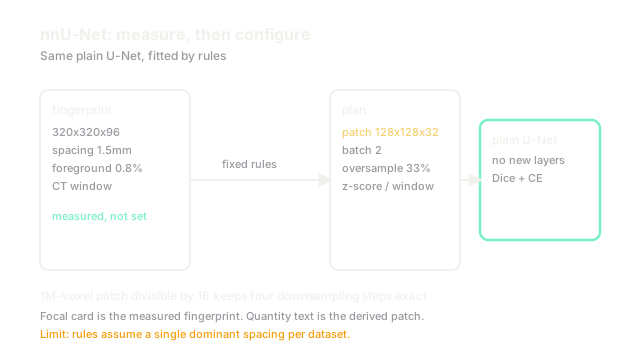
Every lab hand-tuned U-Nets differently, so results never compared. nnU-Net (2021) fixes the recipe: fingerprint the dataset (spacing, size, intensity), apply rules for patch, depth, and batch, then train with Dice plus cross-entropy and mirror ensembling. Input is any labeled medical set; output is a configured 2D, 3D, or cascade plan. Tuning starts after the baseline, not before.
Think of It Like This
A race mechanic who measures the track first
A good mechanic walks the track, notes hairpins and straights, then picks gears and tires by rule book instead of taste. Custom tweaks come only after the rule-book car laps.
Fingerprints are track walks and rules are gear tables. The analogy stops at data: tracks stay fixed while scans vary per patient.
How It Actually Works
Fingerprint records median spacing, shape, and intensity percentiles. Rules resample to median spacing, set patch near within GPU memory, depth to cover receptive field, batch for 3D. Training uses Dice plus cross-entropy with deep supervision. Inference tiles with percent overlap plus mirroring.
Worked example
A liver CT set has spacing mm and median shape . Rules resample to isotropic for 3D, patch , batch on GB. Five-fold training gives Dice liver. Skipping resampling drops to because mm slices smear domes. That gap is the fingerprint gain.
Watch Out For
Tiny lesions drowned by default sampling
Default oversampling misses mm tumors in -slice livers. The symptom is high organ Dice with zero lesion recall. Raise foreground oversampling to percent for lesion sets.
The Quick Version
- nnU-Net configures U-Nets from dataset fingerprints by rule.
- Median spacing sets resampling; memory sets patch near .
- Dice plus cross-entropy with mirroring forms the baseline.
- Do not hand-tune before running the rule-book plan.
- Tiny lesions need extra oversampling beyond defaults.