SAM Cuts Masks From Any Prompt
SAM encodes images once then decodes masks from points, boxes, or text, so one foundation model segments anything zero shot.
Why Does This Exist?
Every new mask task trained a new model on small masks. Labeling SA-1B scale by hand would take years.
SAM splits heavy encode from light prompt. It lifts semantic segmentation zero shot, aids instance segmentation proposals, and pairs with open vocabulary boxes.
Think of It Like This
A printed photo plus tracing overlays
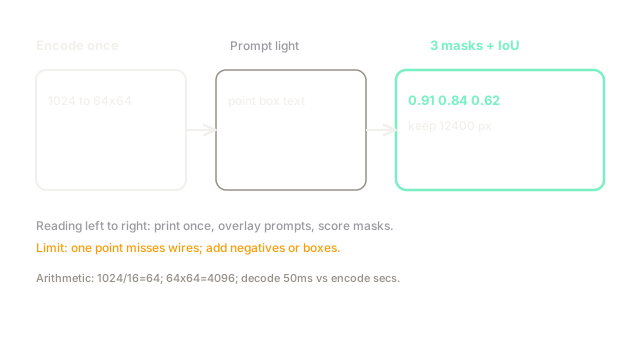
You print one sharp photo once, then lay thin overlays for each request: circle the dog, box the car. Printing stays once while overlays stay cheap.
Image encoder is printing, prompt decoder is overlays. Where it stops: blurry prints limit overlays, just as weak encodings cap prompt masks.
How It Actually Works
ViT-H encodes to once. Prompt encoder embeds points, boxes, masks. Light decoder cross attends prompts to image and outputs masks plus IoU scores to handle ambiguity. Data engine grew to M photos and B masks.
Worked example
Point at on a dog. Decoder outputs masks with areas , , pixels and IoU preds , , . Keep whole dog. Encode costs seconds once, decode costs ms per prompt, so prompts amortize the print.
Watch Out For
Prompting tiny structures with one point only
One point on a wire yields the pole blob instead. Symptom: coarse masks on thin parts. Fix: add negative points or a tight box for thin targets.
The Quick Version
- SAM encodes once with ViT-H to features, decodes prompts lightly.
- Points, boxes, or text give three masks plus IoU to resolve ambiguity.
- Fixture IoU picks whole dog over parts.
- M photos and B masks power zero shot transfer.
- Add negatives or boxes for thin structures.