Panoptic Segmentation
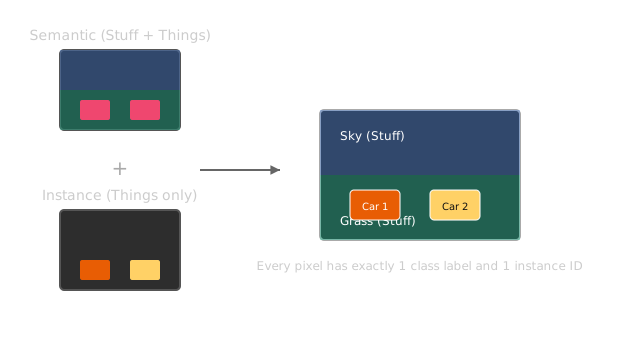
Panoptic segmentation gives every pixel one class label and one instance ID, parsing countable things and uncountable stuff in a single non-overlapping map.
Why Does This Exist?
Semantic segmentation labels every pixel with a class but merges all cars into one blob, so a tracker cannot follow any single car. Instance segmentation separates the cars but ignores the background entirely, so a planner never learns where the drivable road is. Real systems need both answers in one map: which pixels belong to each countable object, and which belong to the surfaces around them.
Panoptic segmentation (Kirillov and colleagues, 2019) demands exactly that: every pixel gets one class label and one instance ID, with no overlaps and no gaps. Countable objects such as people and cars are things, each with its own ID; amorphous regions such as sky and road are stuff, sharing one ID per class. This page covers the things-versus-stuff contract, the panoptic quality metric with worked numbers, and the two architecture families. The semantic branch is encoder-decoder segmentation, the instance branch is Mask R-CNN, and the foundation-model sequel is Segment Anything.
Think of It Like This
Assigned seating plus labeled floor zones
A wedding planner maps every square foot of the hall exactly once. Each guest gets a named chair, Anna chair 3 and Ben chair 4, while shared areas get zone labels: dance floor, buffet, aisle. No two assignments overlap, and no floor is left unassigned.
Things are the named chairs, stuff is the dance floor, and the non-overlap rule is the planner refusing double bookings. The analogy stops at motion: guests wander off their chairs, while pixels stay put, and the planner never has to trade recognition against boundary precision the way the metric does.
How It Actually Works
Each pixel receives a pair , where is the semantic class and is the instance ID. Thing pixels carry their own per object, so two cars differ; stuff pixels share one per class, so all road is one segment. The non-overlap rule forces exactly one pair per pixel: when two predicted masks claim the same pixel, confidence and depth ordering pick the winner and the loser yields.
Quality is panoptic quality, . A true positive (TP) is a predicted segment whose IoU with exactly one ground-truth segment exceeds 0.5. The rest are false positives (FP, phantoms) and false negatives (FN, misses). Recognition quality is the F1 score over segments, and segmentation quality is the mean IoU over matched TP pairs. Here IoU is intersection over union of two masks, counts matched segments, and the halves split each error between precision and recall.
Two routes to one map
Two-stream models run a shared backbone into parallel heads, an instance head and a semantic head, then fuse with a heuristic that prioritizes confident things and fills the rest with stuff. Unified models such as Mask2Former instead predict a fixed set of masks with class labels through masked attention, matched to ground truth by bipartite matching, which enforces non-overlap by construction and drops the heuristics.
Worked quality scores
Three predicted cars match ground truth with IoUs 0.8, 0.7, and 0.9, plus one phantom prediction and one missed car. So , , . Recognition quality is . Segmentation quality is . Panoptic quality is . One number says both halves at once: a quarter of the segments were mishandled, and the found ones average 0.8 boundary overlap.
Code
ious = [0.8, 0.7, 0.9]fp = fn = 1tp = len(ious)rq = tp / (tp + 0.5 * fp + 0.5 * fn)sq = sum(ious) / tpprint(round(rq, 4), round(sq, 4), round(rq * sq, 4))# -> (0.75, 0.8, 0.6)Recognition quality of 0.75 times segmentation quality of 0.8 gives panoptic quality 0.6.
Watch Out For
Overlapping annotations that fight the contract
Training masks where one object extends behind another feed the model contradictory labels for the same pixel, since panoptic training demands exactly one label each. The symptom is a depressed quality score with ragged boundaries at occlusions. Reformat annotations to strict non-overlap with a depth-ordered winner before training.
Grading panoptic models with mean IoU alone
Mean IoU averages per-class overlap and barely notices a missed rare object, so a model that drops whole instances can still look fine. The symptom is strong IoU beside weak panoptic quality on the same predictions. Report panoptic quality alongside, because its recognition half punishes misses directly.
The Quick Version
- Panoptic segmentation assigns every pixel one class label and one instance ID.
- Things are countable objects with per-object IDs, and stuff is background with one shared ID.
- Predictions never overlap and never leave gaps by construction or by fusion rule.
- Panoptic quality multiplies recognition quality by mean matched IoU in one score.
- Example: three matched cars at IoUs 0.8, 0.7, and 0.9 with one miss and one phantom score 0.6.