Sora-Style Models
Sora-style models generate minute-long coherent video from text by diffusing spacetime patches with transformers, treating clips as sequences to scale.
Why Does This Exist?
Video generation stalled at seconds: flickering subjects, morphing scenes, camera moves that broke physics. Short clips dodged the hard problems, object permanence, 3D consistency, unfolding action, by ending before viewers noticed.
Minute-long generation confronts them. Spacetime patches give transformers a uniform tokenisation across durations and resolutions, and scale does the rest: longer training clips plus bigger backbones yield emergent camera control and physical plausibility. The backbone family is diffusion transformers, the short-clip predecessor is video diffusion, and the architecture survey is video generation architectures.
Think of It Like This
A film crew that rehearsed only commercials
A crew brilliant at thirty-second spots gets hired for a feature film. Early reels show the strain: actors change clothes between cuts, daylight jumps, props wander. More rehearsal time and a stricter script supervisor gradually hold the feature together across ninety minutes.
Clip length is the feature runtime and spacetime training is the rehearsal. Short-clip tricks fail at length exactly where commercial habits fail at features. The remaining wobbles mark rehearsal still in progress, not a different art form.
How It Actually Works
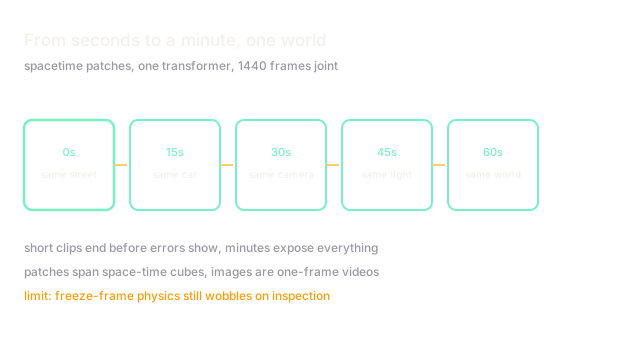
Video compresses into spacetime patches, tokens spanning small space-time cubes, variable in count with duration and resolution. A diffusion transformer denoises the token sequence conditioned on text, with unified handling of images (single-frame videos) and clips in one training mix. Longer contexts train with the same blocks as short ones, so duration scales with compute rather than new architecture:
Reported behaviours include consistent camera moves, persistent objects across cuts, and rough physical plausibility like fluid motion, emerging from scale rather than explicit simulation modules. Prompting controls shot composition, camera path, and style in one description.
Worked example
A -second p shot holds frames. Compressed spatially and temporally, the token grid still spans tens of thousands of patches denoised jointly across dozens of steps. A per-frame model would need independent generations plus stitching; the joint model spends more per step but holds one continuous world. The cost gap is the price of coherence at length.
Code
Frame budgeting that sizes long-clip generation.
def clip_frames(seconds: int = 60, fps: int = 24) -> int: """Raw frames behind one minute-long generated shot.""" return seconds * fps
print(clip_frames()) # -> 1440 frames denoised as one worldWatch Out For
Physics that looks right until inspected
Fluid pours, collisions, and object interactions approximate plausibility without simulation. Casual viewing passes; frame-by-frame inspection reveals volume changes, impossible contacts, and drifting counts.
Scope use to shots nobody freeze-frames for evidence. Physical exactness needs simulators, not samplers.
People and likeness at scale
Minute-long photorealistic humans enable persuasive fabrication far beyond still images. Release demos celebrate capability while provenance lags, and detection trails generation structurally.
Require provenance metadata and consent workflows for human likeness. Treat long video as the highest-risk modality by default.
The Quick Version
- Sora-style models diffuse spacetime patches with transformer backbones.
- One architecture spans images and minute-long clips through unified tokenisation.
- A -second shot holds frames denoised as one continuous world.
- Camera control and rough physics emerge from scale, not explicit modules.
- Freeze-frame physics and human-likeness misuse are the standing risks.