Video Understanding
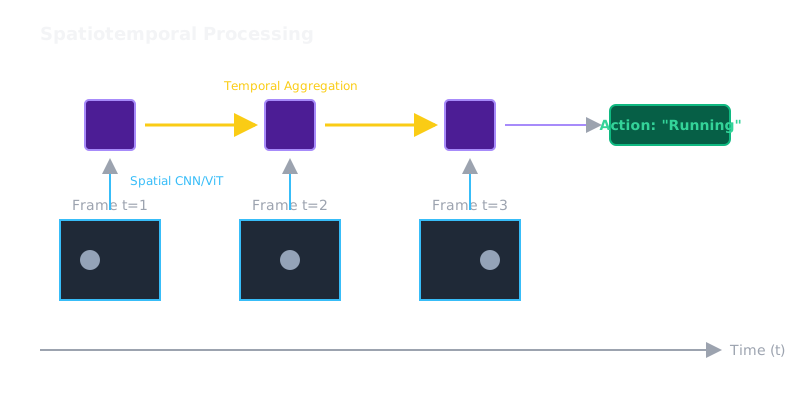
A single frame cannot tell sitting down from standing up mid-motion. Video understanding reads how frames change over time, fusing what each frame shows with how pixels move.
Why Does This Exist?
A single frame often cannot settle what is happening: sitting down and standing up look identical mid-motion, and a raised arm means waving, throwing, or stretching depending on what came before. Frame-by-frame classifiers guess from posture while ignoring the sequence that disambiguates it. Video understanding exists to read that sequence, turning "what is in this picture" into "what is happening across these frames" for surveillance, sports analytics, driving perception, and summarization.
This page covers the spatial-plus-temporal mechanism and stream fusion. Single-label clips are video classification; human verbs are action recognition; pixel motion basics live in optical flow.
Think of It Like This
A flipbook, not a painting
Judging a movie from one poster tells you the cast and the setting but nothing about the plot. A flipbook tells the story: each page is a static sketch, and flipping through the stack turns small changes between pages into motion.
Video models read flipbooks. The spatial stream studies each page, the motion stream studies how sketches shift between pages, and fusion decides the action. The analogy stops at memory: you recall the whole story, while most models only relate frames inside a short sampled window.
How It Actually Works
The two feature kinds
A clip is frames through . The spatial path embeds sampled frames into vectors that record objects and scenes; the temporal path records change, either as 3D convolutions sliding across height, width, and time, as a second stream reading pixel-motion fields, or as transformer attention relating distant frames. Late fusion averages the verdicts, for example , and a classification or localization head turns the fused features into a label or event boundaries. Sampling keeps this affordable: evenly spaced frames stand in for the full frame rate.
Worked fusion example
A 30-second clip at 30 frames per second holds 900 frames. Sampling 16 of them steps every , so about every 56th frame, roughly 1.9 seconds apart, and still covers the whole clip. On a sitting-down test the spatial stream is unsure at while the motion stream sees the descent clearly at . Equal fusion gives : a usable verdict neither stream reaches alone, and the gap over the frame-only score is exactly why motion earns its compute.
Code
frames = list(range(0, 900, 56))[:16]print(len(frames), frames[0], frames[-1])# -> 16 0 840spatial = [0.55, 0.45]flow = [0.85, 0.15]fused = [(a + b) / 2 for a, b in zip(spatial, flow)]print(fused)# -> [0.7, 0.3]Watch Out For
Static bias standing in for motion
Datasets pair actions with settings, so models learn that water means swimming instead of learning the stroke. The symptom is a frame-only probe matching the full model, for instance 0.92 against 0.94, a 2-point gap that says background does the work. Test on single frames and diversify backgrounds until the gap grows.
Sampling densely into memory failure
Feeding full frame rates to a 3D model exhausts memory on long clips. The symptom is an out-of-memory crash that tempts shrinking the batch to 1 and destabilizing training. Sample sparsely first and freeze the frame backbone before reaching for denser input.
The Quick Version
- One frame cannot separate sitting down from standing up; the frame sequence can.
- Spatial features record what each frame shows, temporal features record how it changes.
- Sixteen samples at stride 56 cover a 900-frame clip with about 1.9 seconds between samples.
- Equal fusion of 0.55 frame and 0.85 flow scores yields 0.70, beating either stream alone.
- Frame-only probes near full accuracy expose static bias, not motion understanding.