Sparse Autoencoder
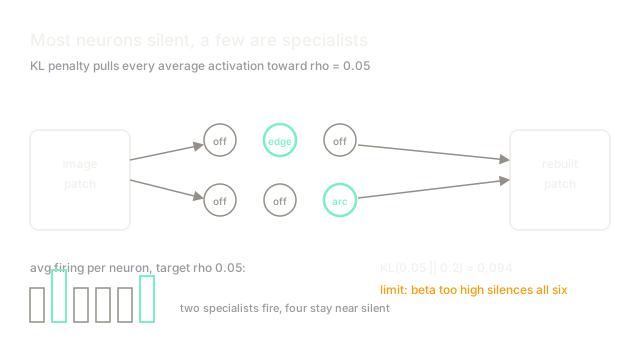
A sparse autoencoder forces most bottleneck neurons to stay near silent, so each one ends up standing for one clean visual pattern instead of a blur.
Why Does This Exist?
Give an autoencoder a wide bottleneck and it spreads every image across every neuron. Reconstructions are fine, but no single neuron means anything, so the features transfer poorly and teach you nothing about the data.
Sparsity fixes the blur. By demanding that each hidden neuron stay near zero on almost every input, the network can no longer smear responsibility around. Each neuron must earn its rare activations by detecting one specific thing: a vertical edge, a red patch, an eye corner. The result is a parts list of the dataset instead of a smoothie of it.
This page teaches the sparsity penalty. The plain autoencoder underneath is covered in autoencoders, and the glossary entry pins the one-line meaning. Corruption-based training is the sibling trick in denoising autoencoder.
Think of It Like This
A repair crew where only two people may work at once
A building manager allows only two repair workers on site per day out of a crew of forty. With everyone idle most days, nobody can coast as a generic helper. Each worker must become the single best person for one specific job, the boiler expert, the window expert, so that on their rare active day they carry the whole repair alone.
Dense bottlenecks are crews where everyone shows up and nobody is accountable. Sparsity is the two-worker rule, and it manufactures specialists. It breaks down when jobs truly need a crowd, genuinely distributed patterns get chopped into fragments no single specialist covers.
How It Actually Works
Let be the average activation of hidden neuron over the training batch, and pick a small target sparsity , typically . Add a penalty that pushes every toward :
sets how much you care about sparsity versus reconstruction. The KL term is zero when and grows whenever a neuron fires too often. Neurons may also fire too rarely, the penalty is two-sided, but in practice the reconstruction term keeps useful neurons alive.
Why rare firing means clean features
A neuron active on half the images must describe half the dataset, so it learns an average. A neuron active on one image in twenty can afford to match exactly those images, a left-facing curve, a wheel arc. Overcomplete bottlenecks, more hidden neurons than inputs, only work with this penalty; without it the extra capacity memorises.
Worked example
Set and suppose a neuron currently averages . The penalty is . Push the neuron down to and the penalty hits exactly zero. With , that contributes to the loss, a firm shove toward silence that only genuinely useful detections resist.
Code
Average activation plus the KL penalty, the two lines that make the bottleneck sparse.
import math
def kl_sparsity(rho: float, rho_hat: list[float]) -> float: """KL(rho || rho_hat) per neuron, averaged over the hidden layer.""" total = 0.0 for r in rho_hat: r = min(max(r, 1e-6), 1 - 1e-6) # keep logs finite total += rho * math.log(rho / r) + (1 - rho) * math.log((1 - rho) / (1 - r)) return total / len(rho_hat)
h_mean = [0.45, 0.075, 0.35] # average firing of 3 hidden neuronsprint(h_mean) # -> [0.45, 0.075, 0.35]print(round(kl_sparsity(0.05, h_mean), 4)) # -> 0.2259Watch Out For
Dead neurons from an oversized beta
Crank too high and the cheapest way to minimise the loss is silence: every collapses to zero and reconstruction dies with it. The loss looks excellent on the sparsity term while the outputs are grey mush.
Raise gradually from a small value and watch the fraction of neurons that never fire. If it climbs past a third of the layer, back off. Sparsity should thin the crowd, never empty the room.
Sparsity on the wrong activation scale
The KL penalty assumes activations in , as from a sigmoid. Apply it to unbounded ReLU outputs averaging and the log terms produce garbage gradients that wreck training within epochs.
Match the penalty to the nonlinearity: sigmoid or normalised activations for KL sparsity, or switch to an L1 penalty on activations, which needs no range assumption.
The Quick Version
- A sparse autoencoder penalises frequent firing, targeting about percent activity per neuron.
- Rare firing forces each neuron to specialise in one clean pattern instead of a blurry average.
- The KL penalty for target against actual equals per neuron.
- Overcomplete layers with more neurons than inputs only work under this penalty.
- Too much penalty kills every neuron, and KL sparsity needs activations bounded in .