Sports Analytics Vision
Cameras follow players and the ball to count sprints, passes, and spacing, so coaches see what won the point, not just the score.
Why Does This Exist?
A coach watching live misses off ball runs. A 90 minute match holds 22 players times 5,400 seconds of motion. Sports vision exists to convert that video into numbers: who sprinted, how far, which pass broke the line, how wide the defense stood.
Detection starts it. Multi-object tracking keeps identities through occlusions. Two-dimensional pose adds knees and hips for stride. This page is the sports layer: pitch calibration, team assignment, and event rules that turn tracks into tactics.
Basics first: the pitch is calibrated from lines to meters with a homography. Pixel speed means nothing until divided by that scale. Jersey color plus number reads team and identity.
Think of It Like This
Chess notation for a match
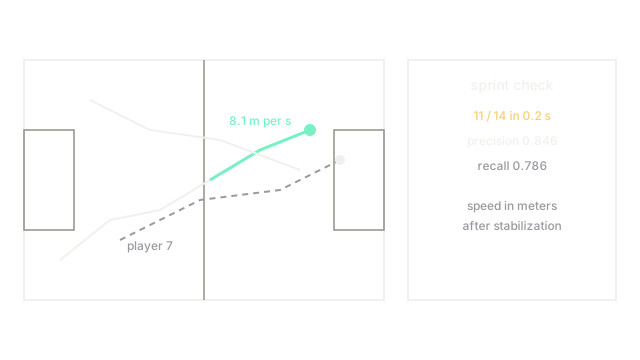
Chess players replay games from notation, not memory: knight to f3, pawn takes. Tracking is notation for football: player 7 sprinted 24 meters at 8.1 meters per second, pass from x 30 to x 62 broke two lines. The video is the board. The analogy stops at certainty: chess moves are exact, while tracks jitter and need smoothing before speeds trust.
How It Actually Works
Overhead cameras calibrate to pitch meters. A detector finds players and the ball each frame. A tracker links boxes into 22 tracks plus ball. Jersey classifiers assign team. Pose lifts keypoints for stride. Speed comes from smoothed positions divided by time. Events fire on rules: a sprint exceeds 7 meters per second for 1 second, a pass is a ball velocity flip between teams.
Identity swaps are the assumption. Occlusions at corners swap numbers. Systems keep a gallery of number crops and reassign on clear views, marking uncertain segments rather than guessing.
Worked sprint count
One half holds 14 true sprints over 7 meters per second. The system reports 13: 11 true and 2 false on fast jogs, missing 3 occluded bursts. Precision is 11 divided by 13 which equals 0.846. Recall is 11 divided by 14 which equals 0.786. Total sprint distance sums 312 meters against 348 true, an undercount coaches can correct.
Watch Out For
Broadcast camera motion that fakes speed
A panning broadcast camera adds its own motion to every pixel, so jogging looks like sprinting when the camera whips. The symptom is sprint spikes aligned with camera moves. Fix it by stabilizing to pitch coordinates first and by computing speed in meters, never pixels.
The Quick Version
- Sports vision calibrates pixels to meters, then tracks players and ball.
- Speeds come from smoothed tracks, events from threshold rules.
- Our half found 11 of 14 sprints, precision 0.846 and recall 0.786.
- Reidentify numbers from clear crops, mark occluded gaps unknown.
- Always measure speed in pitch meters after stabilization.