Action Recognition in Video
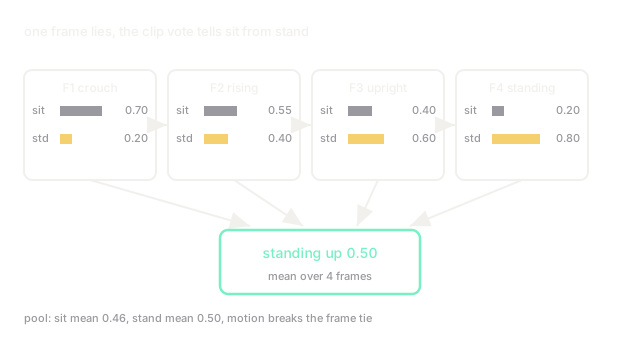
Action recognition names what someone is doing in a clip by reading appearance and motion together, since one frozen frame cannot tell sitting down from standing up.
Why Does This Exist?
A photo of a person mid-crouch could be the start of a jump or the end of a sit: the label lives in the motion, not the frame. Early video systems averaged per-frame classifier votes and inherited exactly this blindness. Action recognition exists to model time itself, turning clips into verbs for surveillance, sport analytics and retrieval. The parent picture is video understanding; motion features come from optical flow.
Think of It Like This
Reading a flipbook, not a poster
A movie poster shows you the cast and the mood but never the plot. A flipbook's riffling pages show the punch landing because your eyes track change between pages. Frame-averaging classifiers read posters; action models riffle the flipbook, comparing what each page keeps and what it moves. The analogy stops at the sampling: eyes take every page, while models sample a dozen frames and trust interpolation for the rest.
How It Actually Works
Modern models sample a sparse set of frames across the clip, extract spatial features per frame with a 2D backbone, then fuse them temporally with 3D convolutions, recurrent layers or divided space-time attention. Two-stream designs add an explicit motion stream computed from optical flow. Training uses clip-level cross-entropy, and inference averages predictions over several sampled clips per video.
A worked sampling
A 10-second clip at 30 fps holds 300 frames, far too many to process densely. Sampling 16 frames with stride 18 covers 16 x 18 = 288 frames, nearly the whole clip, at one-eighteenth the cost. Each frame yields a 512-number feature, so the temporal module sees a 16 x 512 sequence and learns that a descending-then-rising torso trajectory means standing up rather than sitting down.
Watch Out For
Scene bias masquerading as motion understanding
Pools predict swimming and tracks predict running even with the athlete masked out, because datasets pair actions with signature scenes. The symptom is high accuracy that survives scrambling frame order. Fix it by testing on shuffled frames (a true motion model must drop) and by debiasing scene backgrounds during training.
The Quick Version
- Actions live in temporal change, so frame averaging is fundamentally blind to them.
- Sparse sampling plus temporal fusion covers long clips affordably.
- Motion streams from optical flow complement raw appearance streams.
- Clip-level training with multi-clip inference is the standard recipe.
- Always check for scene bias by shuffling frames before trusting accuracy.