Style Transfer
Feed-forward style transfer repaints any photo in a learned style in one pass, trading the slow per-image optimisation of early methods for speed.
Why Does This Exist?
The original neural style transfer optimised every image for minutes: hundreds of gradient steps per photo made video impossible and phones hopeless. Artistic filters needed to run in milliseconds on streams, not minutes on stills.
Feed-forward transfer trains the optimisation once into network weights. A transformation network learns to minimise the same content-plus-style loss during training, then stylizes new images in a single pass. Arbitrary-style variants go further, accepting any style image at test time through adaptive normalisation. The optimisation-based origin it descends from is owned by neural style transfer, which teaches the Gatys content-plus-Gram formulation this page builds on.
Think of It Like This
A rehearsed cover band versus a composer
The original method composes a fresh arrangement for every song, weeks of work per performance. A feed-forward network is a cover band that rehearsed the style cold: new song in, same style out, that same night. Arbitrary-style transfer is a band that can mimic any record handed to them at the door.
Rehearsal trades flexibility for speed: the setlist of styles is fixed unless the band learns the general mimicry trick. It fails on songs outside the rehearsal genre, styles far from training that come out muddy.
How It Actually Works
Training minimises over a photo dataset with fixed style targets, where content loss matches deep VGG features and style loss matches Gram or mean-variance statistics. After training, weights are frozen and inference is one forward pass. Arbitrary transfer replaces fixed style with adaptive instance normalisation:
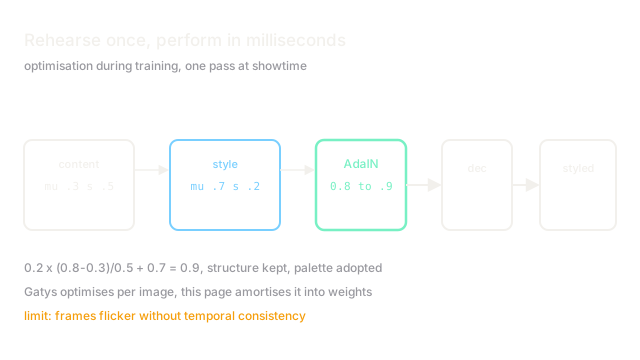
Content features standardise, then adopt the style features' mean and variance. A decoder trained to invert VGG features renders the aligned representation back to pixels.
Worked example
Content feature value with content stats , ; style stats , . AdaIN gives . Structure preserved (relative position within content distribution unchanged), palette and contrast adopted from the style. One forward pass, milliseconds, versus hundreds of optimisation steps.
Code
AdaIN alignment, the operation behind arbitrary style in one pass.
import numpy as np
def adain_transfer(content: np.ndarray, style: np.ndarray) -> np.ndarray: """Adopt style mean and variance onto standardised content.""" c = (content - content.mean()) / (content.std() + 1e-6) return c * style.std() + style.mean()
print(np.round(adain_transfer(np.array([0.8, 0.3]), np.array([0.9, 0.5])), 2)) # -> [0.9 0.5]Watch Out For
Flickering video from per-frame independence
Stylizing frames independently makes brushwork crawl: static scenes shimmer as each frame lands on slightly different textures. Single-image metrics never see it.
Enforce temporal consistency with flow-warped losses or recurrent connections. Evaluate on video clips, not stills, for video products.
Content washed out by style weight
High style weight dissolves faces into texture soup: recognisable people become anonymous swirls. Demos celebrate the soup while users mourn the subject.
Expose the content-style knob to users and default it conservative. Faces need higher content weight than landscapes.
The Quick Version
- Feed-forward transfer trains optimisation into weights, then stylizes in one pass.
- Training minimises content plus style losses; inference needs no optimisation.
- AdaIN turns into by adopting style statistics onto content structure.
- Arbitrary variants accept any style image at test time through the same operation.
- Video needs temporal consistency, and style weight needs a user-facing knob.