Neural Style Transfer
Before diffusion models existed, researchers figured out how to use an image recognition network in reverse to extract the 'content' of a photograph and paint it using the 'style' of a famous painting.
Why Does This Exist?
In 2015, long before the era of prompts and DALL-E, a paper titled A Neural Algorithm of Artistic Style took the internet by storm. People suddenly had apps on their phones that could turn a selfie into a painting by Vincent van Gogh or Pablo Picasso.
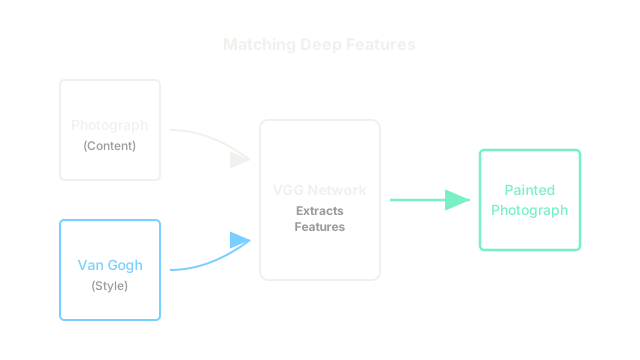
At the time, Neural Networks were mostly used for classification (e.g., "Is this a dog or a cat?"). But researchers made a fascinating discovery about how these networks process images. As an image passes through a Deep Convolutional Neural Network (CNN), the network naturally separates the structure of the image (shapes, edges, layouts) from the texture of the image (colors, brushstrokes). Neural Style Transfer (NST) was born by realizing you could mathematically extract the structure from Image A, extract the texture from Image B, and force the network to combine them into a brand-new image.
Think of It Like This
The Master Forger
Imagine a highly skilled art forger who is entirely blind, but possesses a magical set of sieves.
- The Content Sieve: You pass a photograph of your house through this sieve. It strips away all color and lighting, leaving only a rigid wireframe of the house's shape.
- The Style Sieve: You pass Van Gogh's Starry Night through a different sieve. It strips away the shapes of the stars and the village, capturing only the swirling blue paint and the aggressive brushstrokes.
The forger takes the rigid wireframe (Content) and covers it entirely in the swirling blue paint (Style), resulting in a perfect Van Gogh painting of your house.
How It Actually Works
Neural Style Transfer is unique because it doesn't train a neural network. Instead, it takes a pre-trained network (usually VGG-19, a famous image classifier) and freezes its weights. It then uses gradient descent to change the pixels of a blank image until that image matches the desired content and style.
1. Extracting Content
When you feed a photograph into the VGG network, the deeper layers capture the high-level structural layout (the "Content"). We pass the photograph through VGG and save the activations at a deep layer (e.g., block4_conv2).
We then start with a canvas of random white noise. We pass the noise through VGG. Our goal is to change the noise pixels until its activations at block4_conv2 match the photograph's activations perfectly. This is called Content Loss.
2. Extracting Style
Style is fundamentally different from Content. Style is texture, color, and brushstrokes, independent of spatial layout. (A Van Gogh swirl looks like a Van Gogh swirl whether it's in the top-left or bottom-right corner). To capture style, we look at the correlations between different feature maps across multiple layers (from shallow to deep). We calculate this using a Gram Matrix, which essentially measures how often certain features (like "yellow color" and "swirling curve") appear together anywhere in the image. We calculate the Gram Matrices for the Van Gogh painting. Our goal is to change the noise pixels until its Gram Matrices match the Van Gogh Gram Matrices. This is called Style Loss.
3. The Optimization Loop
We combine the Content Loss and the Style Loss into a single Total Loss. We use backpropagation, but instead of updating the weights of the neural network (which are frozen), we update the raw RGB values of the noisy canvas. Slowly, over hundreds of iterations, the noise morphs into a beautiful combination of the photograph's structure and the painting's texture.
Code
This code highlights the core mathematical trick of NST: calculating the Gram Matrix to capture style without capturing spatial layout.
import torch
def calc_gram_matrix(tensor): """ Calculates the Gram Matrix of a feature map tensor. This captures the 'Style' by measuring feature correlations. """ # tensor shape: (Batch_Size, Channels, Height, Width) b, c, h, w = tensor.size() # Flatten the spatial dimensions (Height x Width) into a single sequence # Shape becomes (Batch_Size, Channels, Height * Width) features = tensor.view(b, c, h * w) # Calculate the Gram Matrix by multiplying the features by their transpose # This results in a (Channels, Channels) matrix. # It tells us: "How often does Feature 1 fire at the same time as Feature 2?" gram = torch.bmm(features, features.transpose(1, 2)) # Normalize by the number of elements to prevent massive values gram = gram / (c * h * w) return gram
def style_loss(generated_features, target_style_gram): """ The style loss is simply the Mean Squared Error between the Gram Matrix of the image we are generating and the Gram Matrix of the Van Gogh painting. """ generated_gram = calc_gram_matrix(generated_features) loss = torch.nn.functional.mse_loss(generated_gram, target_style_gram) return lossWatch Out For
The Optimization Bottleneck
The original formulation of Neural Style Transfer described above is extremely slow. Because you have to run a forward pass and a backward pass through a massive VGG network hundreds of times just to generate one single image, it couldn't be used for real-time video filters. Later researchers invented "Fast Neural Style Transfer," which trains a separate Feed-Forward network to approximate a specific style in a single pass, enabling the real-time Snapchat and Instagram filters we have today.
The Quick Version
- Neural Style Transfer combines the structure (Content) of one image with the texture and colors (Style) of another.
- It uses a pre-trained Image Classification network (like VGG) to evaluate the image.
- It captures Content by looking at the deep layers of the network.
- It captures Style by calculating a "Gram Matrix," which measures how different visual features correlate across the image regardless of where they are located.
- The algorithm starts with a noisy image and slowly alters its pixels until it simultaneously minimizes the Content Loss and the Style Loss.
- It was one of the first major viral successes of generative AI, laying the groundwork for how neural networks understand abstract artistic concepts.