Trustworthy Vision Overview
A vision system earns trust from four separate checks, not one score. Robustness, calibration, fairness, and audit logs each pass or fail on their own.
Why Does This Exist?
A classifier can top a leaderboard and still fail deployment: fooled by stickers, overconfident on strange inputs, worse on underrepresented groups, with no record of what shipped. Each failure needs a different test, and passing three of four is still a failure.
Trustworthy vision is the release checklist that runs all four. Robustness and security covers evasion and corruption. Calibration covers confidence honesty. Fairness and bias covers slice gaps. Logging covers who approved what on which evidence. This page maps the four and prices each; the method pages carry the details.
Think of It Like This
A bridge opening inspection
A new bridge needs four separate sign-offs: load test, sway measurement, lane markings visible in rain, and the paperwork naming the steel batch. A bridge that holds weight but has invisible markings in rain does not open.
Vision releases work the same way. The load test is adversarial and corruption robustness. The sway check is calibration. The markings check is fairness slices. The paperwork is the audit log. The analogy stops at interaction: bridge checks are independent, while vision fixes interact, since robustness training often worsens calibration.
How It Actually Works
The four gates run in order on the release candidate. Robustness reports flips under PGD at a stated budget plus error under common corruptions. Calibration reports expected error between stated confidence and observed accuracy. Fairness reports the worst slice gap across documented groups. Logging records data version, checkpoint, eval commit, approver, and rollback pointer. A release needs all four numbers beside the headline accuracy.
The demo gate numbers
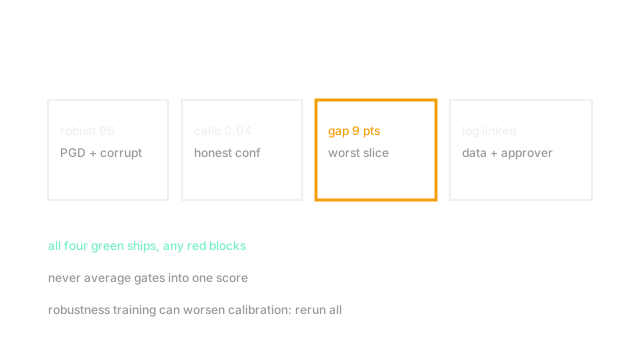
On a demo classifier: PGD at budget 0.03 flips 4 of 100 (96 resisted), corruption error rises 8 points, calibration error is 0.04, the worst slice gap is 9 points, and the log links all four runs. Shipping needs thresholds set in advance, for example flips under 10, calibration error under 0.05, slice gap under 10 points. One gate red blocks the release even when accuracy is the best yet.
Watch Out For
Averaging four gates into one trust score
A single blended score lets a strong accuracy hide a failing fairness slice. The symptom is a green badge with an unexamined red gate inside. Keep four separate numbers with four thresholds, and block on any red.
The Quick Version
- Trustworthy vision runs four gates: robustness, calibration, fairness, and audit logs.
- Each gate has its own metric and threshold; passing three of four still blocks release.
- On the demo build the gates read 96 resisted, 0.04 error, a 9-point gap, logged.
- Robustness fixes can worsen calibration, so re-run all gates after every fix.
- Never ship on headline accuracy alone.