TSN Votes Across Video Segments
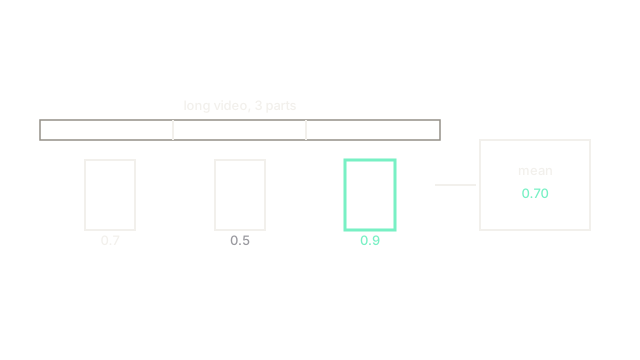
TSN splits a video into a few distant segments, scores one frame from each, then averages the votes into one video decision.
Why Does This Exist?
Dense 3D clips watch seconds, not minutes. A two-minute action spreads its evidence across the whole timeline, and a 16-frame window sees only one slice of it.
TSN samples sparsely across the full video instead. It supports video classification, feeds action recognition, and stays cheaper than dense volumes like two-stream networks by scoring few frames well spaced.
Think of It Like This
Three jurors watching different acts
Three jurors each watch one act of a play and vote. No juror sees everything, but together they cover the whole show.
It fails when the key moment falls between sampled acts. Sparse votes miss brief events that dense watching would catch.
How It Actually Works
Split video into equal segments, where sets temporal coverage. From segment pick one frame and score it , where is the shared image model. The video score is the mean , where averaging makes every segment count equally.
Worked example
Scores come back , , . Then . One strong 0.9 segment plus two middling votes still passes threshold 0.5. A dense 16-frame clip stuck in segment two would see only 0.5 and call it negative.
Watch Out For
Averaging away a brief action
A two-second dive inside a two-minute swim averages down to noise. The symptom is high per-segment peaks with a flat video mean. Replace plain mean with top- pooling or learned weights when actions are brief.
The Quick Version
- TSN splits video into segments and scores one frame each.
- Video score is the mean of segment scores, here 0.70 from 0.7, 0.5, 0.9.
- Sparse sampling covers minutes while dense clips cover seconds.
- Shared weights keep it cheap, and flow streams add motion.
- Brief actions need top- pooling, not plain averaging.