VAR Visual Autoregressive Modeling
VAR predicts images scale by scale instead of pixel by pixel, generating a thumbnail first and then each finer resolution in one parallel step.
Why Does This Exist?
Pixel-by-pixel autoregression is correct and unusable: sequential steps per image makes high-resolution sampling crawl. The ordering itself is the inefficiency, since it ignores how images actually compose, globally first, details later.
VAR redefines the autoregressive unit as the scale. Predict the thumbnail, then the map given it, doubling up to full resolution, with all tokens inside one scale predicted in parallel. Ten steps replace a thousand. The hierarchical token idea it builds on comes from VQ-VAE-2, and the pixel-order baseline is PixelCNN.
Think of It Like This
A painter working thumbnail to canvas
A painter starts with a one-inch thumbnail: composition only. Then a small study, then a half-size canvas, then the full mural, each stage copying the previous one's layout and adding one level of detail everywhere at once. Nobody paints murals one bristle-dot at a time in reading order.
Scales are the study sizes and parallelism is painting each whole study at once. The method fails when a detail needed at the end was never hinted in the thumbnail, so coarse maps must carry enough layout to anchor everything above.
How It Actually Works
The quantiser produces token maps at doubling resolutions, through for -pixel images with scales. The transformer models:
Conditioning uses all previous (upsampled) maps, and every token within generates in parallel. Training is next-scale cross-entropy; sampling runs forward passes total. Block-causal attention masks enforce the scale ordering while staying parallel inside each scale.
Worked example
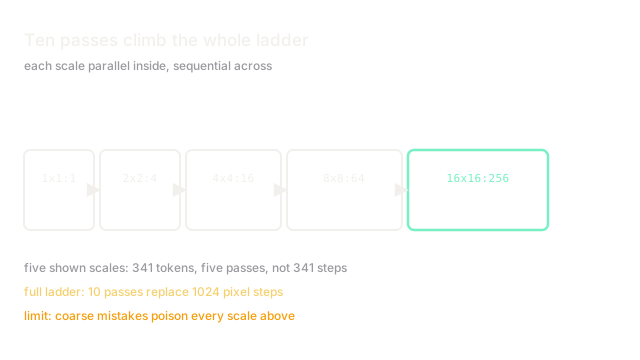
Scales (five shown of ten): token counts , summing to tokens for the visible ladder and across all ten scales to . Sampling needs passes versus pixel steps, a hundredfold cut, while likelihood stays competitive because the factorization respects image structure better than raster order does.
Code
Scale ladder token counts, showing where the parallelism comes from.
def var_ladder(scales: int = 10) -> list[int]: """Token counts per scale from 1x1 doubling upward.""" return [(2 ** k) ** 2 for k in range(scales)]
ladder = var_ladder(5)print(ladder) # -> [1, 4, 16, 64, 256] tokens per scaleprint(sum(ladder)) # -> 341 tokens across the five shown scalesWatch Out For
Coarse errors compounding upward
Every scale conditions on all previous ones, so a bad layout poisons all eight scales above it. There is no revision pass; the ladder only climbs.
Invest capacity in early scales and verify thumbnails before trusting details. Rejection-sample at coarse levels where it is cheap, not at full resolution.
Quantiser mismatch across scales
One shared codebook must serve thumbnails and fine textures alike. Starve either end and its scales degrade; the ladder is only as strong as its weakest resolution.
Check per-scale reconstruction separately during tokeniser training. Scale-specific codebooks cost parameters but buy uniform quality.
The Quick Version
- VAR factorises generation over scales, not pixels: .
- All tokens within one scale generate in parallel; only scales run sequentially.
- Ten passes replace pixel steps for token maps.
- Our five-scale ladder holds tokens.
- Coarse mistakes compound upward, and the codebook must serve every scale evenly.