Aleatoric vs Epistemic Uncertainty
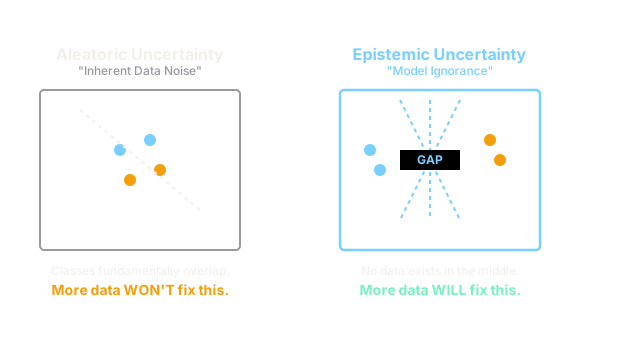
When a model is unsure, it is for one of two reasons: the data is noisy (Aleatoric) or the model is ignorant because it hasn't seen this before (Epistemic).
Why Does This Exist?
When a machine learning model outputs a prediction of "50% Yes, 50% No," it is expressing uncertainty. But why is it uncertain?
In high-stakes environments (like self-driving cars or medical diagnostics), knowing why the model is unsure is just as important as the prediction itself. If the model is unsure because the camera is covered in mud, that requires a different response than if the model is unsure because it has never seen a kangaroo in the road before.
Machine learning mathematically divides uncertainty into two distinct buckets:
- Aleatoric Uncertainty (Data Noise)
- Epistemic Uncertainty (Model Ignorance)
By calculating which type of uncertainty is occurring, engineers know exactly how to fix the problem—or if the problem can be fixed at all.
Think of It Like This
Imagine flipping a coin.
Aleatoric Uncertainty: You flip a perfectly normal coin. What are the odds it lands on heads? 50%. Even if you flip the coin a million times to gather more "training data," you will never be able to predict the next flip with 100% certainty. The uncertainty is inherent to the physical chaos of the flip. More data will not help you.
Epistemic Uncertainty: I hand you a coin you have never seen before. It is heavy on one side. I ask you to predict the outcome. You say "50%," but only because you are completely ignorant about how this specific coin behaves. If I let you flip it 100 times, you would learn its bias, and your prediction would change to "90% heads." The uncertainty was just ignorance, and more data completely solved it.
How It Actually Works
1. Aleatoric Uncertainty (Statistical Noise)
The word aleatoric comes from the Latin word for a dice game. It refers to uncertainty that is baked into the data itself.
Imagine a dataset predicting whether someone will buy a sports car based only on their age and income. You find two people who are both 45 years old and make $150,000. One buys the car, the other doesn't. Because your features (Age, Income) do not capture everything about human psychology, the data appears contradictory. The model cannot draw a clean line between buyers and non-buyers. It will predict 50%.
- The Fix: You cannot fix aleatoric uncertainty by gathering more rows of data. You must gather new features (e.g., adding a column for "Midlife Crisis Status").
2. Epistemic Uncertainty (Model Ignorance)
The word epistemic comes from the Greek word for knowledge. It refers to uncertainty caused by a lack of training data in a specific mathematical region.
Imagine training an autonomous vehicle entirely in sunny California. Suddenly, it drives into a blizzard in Colorado. The model's hidden layers have never processed white pixels representing snow. It predicts a 50% chance of a clear road. The model is guessing.
- The Fix: You fix epistemic uncertainty by gathering more data. If you train the model on 10,000 images of blizzards, it will learn the pattern, the epistemic uncertainty will drop to zero, and it will correctly predict a dangerous road.
Code
In traditional deep learning, a single neural network cannot easily separate these two uncertainties. You often need an ensemble of models or Bayesian Neural Networks to calculate them. Here is the conceptual approach using an ensemble.
import numpy as np
def calculate_uncertainties(ensemble_predictions: np.ndarray): """ Given an ensemble of 5 models predicting a continuous value (e.g., house price). ensemble_predictions shape: (num_models, num_samples) """ # 1. Total Uncertainty (Variance across all models' predictions) # If the models violently disagree with each other, epistemic uncertainty is high. epistemic_uncertainty = np.var(ensemble_predictions, axis=0) # 2. Aleatoric Uncertainty # To calculate this, the models themselves must output a variance (sigma) # for each prediction, indicating how noisy the training data was in that area. # (Assuming we have a function `get_aleatoric_outputs`) # aleatoric_uncertainty = np.mean(get_aleatoric_outputs(), axis=0) return epistemic_uncertainty
# If epistemic_uncertainty is very high for a specific row, # the models are saying "We have never seen data like this before!"# (Out-of-Distribution detection).Watch Out For
Ignoring Out-of-Distribution Data
A standard, single neural network is dangerously overconfident. If you train a network on cats and dogs, and show it a picture of a car, it will often predict "Dog (99% confidence)" because it has no mechanism to express epistemic uncertainty. It doesn't know what it doesn't know. To safely deploy ML in the real world, you must use specialized techniques (like Monte Carlo Dropout, Ensembles, or Conformal Prediction) to force the model to calculate its own ignorance.
The Quick Version
- Aleatoric Uncertainty is noise inherent in the data. Adding more rows of data will not fix it; you must add better features or better sensors.
- Epistemic Uncertainty is ignorance in the model caused by a lack of training data. Adding more data in that specific domain will completely fix it.
- Standard neural networks cannot distinguish between the two, and often fail to express epistemic uncertainty at all (resulting in dangerous, overconfident hallucinations).
- Real-world AI systems use ensembles or Bayesian methods to measure epistemic uncertainty so they can safely say, "I don't know, I've never seen this before."