Gradient Boosting for Forecasting
Using powerful tabular models like XGBoost to forecast time series by manually converting the time element into columns of historical features.
Why Does This Exist?
Classical time series models like ARIMA have two major flaws:
- They are strictly univariate. If you want to predict umbrella sales, ARIMA only looks at past umbrella sales. It cannot easily look at tomorrow's weather forecast.
- They assume linear relationships.
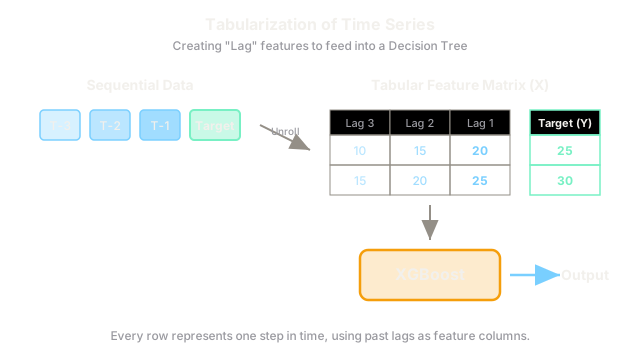
Gradient Boosting models (like XGBoost or LightGBM) are the absolute kings of tabular data. They easily handle hundreds of external features (weather, holidays, price changes) and non-linear interactions. However, they don't natively understand "time". To use them for forecasting, we have to trick them by mathematically unrolling the timeline into a flat table.
Think of It Like This
Think of It Like This
Imagine you are a detective trying to predict a suspect's next move.
An ARIMA model watches a video tape of the suspect's last 5 days. It intuitively understands the chronological flow of time.
An XGBoost model cannot watch a video. It can only read a spreadsheet. To use XGBoost, you have to hit pause on the video, write down exactly what happened on Day 1 into Column A, what happened on Day 2 into Column B, and so on. You feed the detective the spreadsheet, and they use those columns to guess Day 6.
How It Actually Works
Because XGBoost expects a flat table with rows (X) predicting a target (Y), you must perform Feature Engineering on your time series to convert it into this format.
1. Lag Features
If today is , and you want to predict , you create columns for what happened at , , etc.
sales_lag_1: Sales yesterday.sales_lag_7: Sales exactly one week ago (crucial for capturing weekly seasonality).
2. Rolling Window Features
Instead of just single days, you provide aggregate summaries of the recent past.
sales_rolling_mean_7d: The average sales over the last 7 days.sales_rolling_max_30d: The highest single day of sales in the last month.
3. Calendar Features
XGBoost doesn't know that December 25th is Christmas unless you tell it. You extract integers from the timestamp:
day_of_week: (0 to 6).month: (1 to 12).is_holiday: (0 or 1).
Once this massive table is built, you train a standard Gradient Boosting Regressor to predict the target column based on the engineered feature columns.
Code
In Python, you use pandas to engineer the lags, and then feed the resulting table into xgboost.
import pandas as pdimport xgboost as xgb
# 1. Start with a simple time series# Assume 'sales' contains daily sales datadf = pd.DataFrame({'sales': [10, 15, 12, 20, 25, 30, 22]})
# 2. Engineer Lag Featuresdf['lag_1'] = df['sales'].shift(1)df['lag_2'] = df['sales'].shift(2)
# 3. Engineer Rolling Featuresdf['rolling_mean_3'] = df['sales'].shift(1).rolling(window=3).mean()
# Drop rows with NaN values created by shiftingdf = df.dropna()
print("Engineered Tabular Data:")print(df)# sales lag_1 lag_2 rolling_mean_3# 3 20 12.0 15.0 12.333333# 4 25 20.0 12.0 15.666667# 5 30 25.0 20.0 19.000000# 6 22 30.0 25.0 25.000000
# 4. Train XGBoostX = df[['lag_1', 'lag_2', 'rolling_mean_3']]y = df['sales']
model = xgb.XGBRegressor()model.fit(X, y)
print("\nModel trained successfully!")Watch Out For
Data Leakage.
When calculating rolling features, you must remember to .shift(1) the data first! If you calculate a 3-day rolling average that includes today's sales, and then use that column to predict today's sales, your model will cheat during training and catastrophically fail in production.
Extrapolation Failure.
Decision trees (and by extension, XGBoost) cannot extrapolate. If the highest sales figure in your training data is 100, XGBoost will never predict a number higher than 100. If your time series has an upward trend, XGBoost will flatline into the future. You must explicitly remove the trend (Differencing) before feeding data to XGBoost, and then add the trend back later.
The Quick Version
- Gradient boosting models (XGBoost, LightGBM) are powerful forecasters because they can ingest hundreds of external features (weather, price, holidays).
- They do not natively understand time.
- You must use Feature Engineering to convert chronological time into flat tabular columns (Lags, Rolling Averages, Calendar features).
- Tree-based models cannot extrapolate trends. You must de-trend the data first if it is growing indefinitely.