Model Cards and Transparency
You wouldn't eat packaged food without an ingredients list, and you shouldn't deploy an ML model without documentation explaining exactly what it was trained on, how it performs, and where it fails.
Why Does This Exist?
Historically, machine learning models were shipped as opaque binaries. If a developer wanted to use a model, they had to guess its limitations. This led to disastrous deployments where facial recognition models failed on darker skin tones, or medical imaging models failed on different hospital equipment, simply because the users didn't know the demographic or technical limitations of the training data.
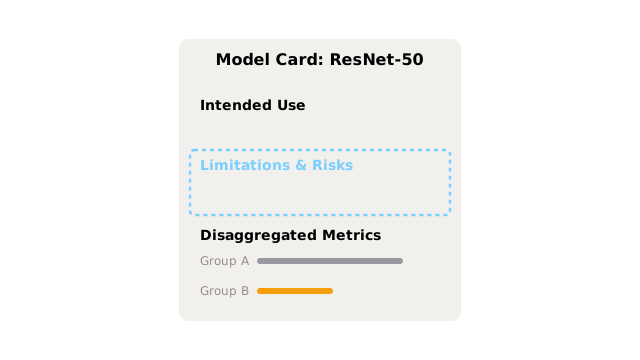
Model Cards (introduced in a seminal 2019 paper by Margaret Mitchell and colleagues) solve this by standardizing transparency. They force creators to explicitly state intended use cases, out-of-scope use cases, training data distributions, and most importantly, disaggregated evaluation metrics (how the model performs across different subgroups, not just overall).
Think of It Like This
Think of a Model Card as a nutritional label on a box of cereal.
The label doesn't just say "Cereal is good." It breaks down the exact ingredients (the training data), the nutritional value per serving (the evaluation metrics), and allergy warnings (the ethical considerations and out-of-scope uses).
Just as a peanut warning prevents a severe allergic reaction, explicitly stating "This model was not tested on pediatric data" prevents a hospital from deploying an adult-trained model on children.
How It Actually Works
A standard Model Card is typically a short document (often 1-3 pages) that accompanies a model checkpoint. It generally contains the following sections:
1. Model Details
The basic metadata: who built the model, when it was trained, the exact version, the model architecture (e.g., ResNet-50, Random Forest), and the license.
2. Intended Use
This is the legal and ethical boundary. It explicitly states the primary intended uses (e.g., "Assisting radiologists in finding anomalies"). Crucially, it must state out-of-scope uses (e.g., "Not intended for automated, unreviewed diagnosis").
3. Factors and Subgroups
This section lists the demographic or environmental factors that the model's performance might be sensitive to. In a face detection model, factors would include skin tone, age, gender, and lighting conditions.
4. Metrics
The overall evaluation metrics (Accuracy, F1-score, RMSE, etc.) alongside the specific fairness metrics chosen (like Demographic Parity). It also explains why those specific metrics were chosen for this specific use case.
5. Evaluation Data
A description of the dataset used to evaluate the model. It is critical that the evaluation data reflects the real-world population, even if the training data did not.
6. Quantitative Analyses (Disaggregated Evaluation)
This is the most important section. Instead of a single accuracy number, the model's performance is broken down across the intersections of the subgroups defined earlier. This reveals if the model is 95% accurate on men but only 60% accurate on women.
7. Ethical Considerations
A narrative section discussing potential risks, data privacy concerns, and mitigating strategies.
Code
While a Model Card is a document, it is often generated automatically from metadata files during the ML pipeline. Google's Model Card Toolkit allows defining this in Python.
import json
# A simplified representation of a Model Card as JSON metadatamodel_card = { "model_details": { "name": "Credit_Risk_Classifier_v2", "organization": "FinTech Corp", "date": "2026-08-21", "architecture": "Gradient Boosting" }, "intended_use": { "primary_uses": ["Predicting loan default probability."], "out_of_scope_uses": ["Fully automated loan rejection without human review."] }, "quantitative_analyses": { "overall_accuracy": 0.88, "disaggregated_performance": { "group_age_18_25": {"accuracy": 0.82, "false_positive_rate": 0.15}, "group_age_26_60": {"accuracy": 0.90, "false_positive_rate": 0.05}, "group_age_60_plus": {"accuracy": 0.87, "false_positive_rate": 0.08} } }}
# This metadata would be rendered into an HTML or Markdown report# -> The user can clearly see the model performs worse on young adults.Watch Out For
Treating it as a PR exercise
Model Cards are useless if they are written by marketing teams to sound good. They must be written by the technical teams who built and evaluated the model, and they must honestly highlight the model's flaws and limitations. A perfect Model Card is a red flag.
Static documentation for dynamic models
If a model is retrained weekly on shifting data, a static PDF Model Card becomes instantly obsolete. Modern transparency requires programmatic Model Cards that update automatically with the CI/CD pipeline.
The Quick Version
- Transparency prevents harmful deployments by making the model's limitations obvious to the end user.
- A Model Card is a standardized document detailing the model's architecture, intended use, and limitations.
- The most critical piece of a Model Card is the disaggregated evaluation: showing how the model performs on specific subgroups, rather than just an overall average.
- Explicitly stating "out-of-scope uses" acts as a boundary to prevent the model from being deployed in scenarios it was never tested for.