Model Explainability (XAI)
When a model makes a high-stakes decision, humans demand to know why. Explainability is the suite of mathematical techniques used to open the 'black box' and reveal which features drove the prediction.
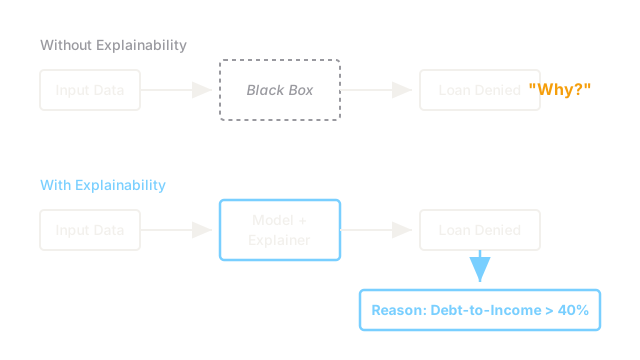
Why Does This Exist?
In the early days of machine learning, models were simple. If you used linear regression to predict house prices, you could look at the learned weight for the square_footage feature and say, "For every additional square foot, the price increases by $150." The model was inherently interpretable.
Today, we use deep neural networks and massive ensemble trees (like XGBoost). These models learn non-linear, highly complex interactions between hundreds of variables. They are black boxes. You feed them data, and they spit out a prediction, but they cannot tell you why they made that prediction.
In a low-stakes environment (like recommending a movie), a black box is fine. But in high-stakes environments—like medical diagnosis, criminal sentencing, or loan approvals—a black box is illegal or unethical. If an AI denies a user a mortgage, the bank is legally required to tell the user why. "The neural network's hidden layers activated in a specific pattern" is not an acceptable answer. Model Explainability (XAI) exists to reverse-engineer the black box and extract human-readable reasons for algorithmic decisions.
Think of It Like This
Think of a black box model like an incredibly talented, but completely non-verbal, chef.
You hand the chef a basket of 50 different ingredients, and 30 minutes later, they hand you a perfect bowl of soup. If the soup tastes slightly too salty, you don't know which of the 50 ingredients caused it, because the chef can't talk to you.
Explainability techniques are like installing security cameras in the kitchen. By watching the footage and experimenting (e.g., hiding the soy sauce next time and seeing how the soup changes), you can mathematically deduce exactly how much each ingredient contributed to the final flavor, even without the chef saying a word.
How It Actually Works
The field of explainable AI is divided into two primary schools of thought: Global Explainability and Local Explainability.
1. Global Explainability (How does the model work overall?)
Global explainability attempts to describe the general behavior of the model across the entire dataset. It answers the question: Which features are the most important, on average?
If you are a bank manager trying to understand your new credit risk model, you want a global explanation. You want to see a ranked list proving that "Credit Score" and "Income" are the most important drivers of the model, while "Zip Code" and "Browser Type" are being ignored.
- Common Techniques: Permutation Feature Importance, Partial Dependence Plots (PDP).
2. Local Explainability (Why did the model make this specific decision?)
Local explainability zoom in on a single row of data. It answers the question: Why was John Doe denied his loan today?
Even if "Credit Score" is the most important feature globally, John Doe might have a perfect credit score. A local explanation calculates exactly which features dragged John Doe's specific prediction down. It might reveal that for this specific prediction, John's unusually high "Debt-to-Income Ratio" overrode his excellent credit score.
- Common Techniques: LIME, SHAP, Individual Conditional Expectation (ICE).
Post-Hoc vs. Intrinsic
It is also important to distinguish between how the explanation is generated:
- Intrinsic: You use a simple model (like a shallow decision tree) that is readable by humans. You sacrifice predictive power for perfect transparency.
- Post-Hoc: You train a massive, opaque black box to get the highest possible accuracy, and then you use secondary mathematical algorithms (like SHAP) to probe the black box and guess why it did what it did. Almost all modern XAI is post-hoc.
Code
While advanced techniques require heavy math, the simplest form of global explainability for tree-based models is built directly into scikit-learn.
from sklearn.ensemble import RandomForestClassifierimport pandas as pd
def get_intrinsic_global_importance( model: RandomForestClassifier, feature_names: list[str]) -> pd.DataFrame: """ Extracts the built-in feature importances from a Random Forest model, providing a basic global explanation of what the model cares about. """ # Extract importances (based on Gini impurity decrease) importances = model.feature_importances_ # Bundle into a DataFrame for readability importance_df = pd.DataFrame({ 'Feature': feature_names, 'Importance': importances }) # Sort highest to lowest importance_df = importance_df.sort_values( by='Importance', ascending=False ).reset_index(drop=True) return importance_df
# Example Output:# Feature Importance# 0 credit_score 0.45# 1 income 0.30# 2 debt_amount 0.20# 3 age 0.05Watch Out For
The Illusion of Truth
Post-hoc explainers (like LIME or SHAP) are essentially models trying to approximate other models. They are not perfect windows into the black box; they are educated guesses. If your underlying model is highly unstable or non-linear, the explanation provided by SHAP might actually be mathematically misleading. Never trust an explainer blindly without validating it against domain knowledge.
Confusing Correlation with Causation
If a global explainer says that "Number of hospital visits" is the most important feature for predicting a high risk of death, it does not mean that visiting the hospital causes death. The model simply found a correlation. Explainability tools only tell you what the model learned from the data; they do not reveal the fundamental causal mechanisms of the real world.
The Quick Version
- Modern machine learning models are opaque "black boxes" that cannot inherently explain their predictions.
- Model Explainability (XAI) is the set of tools used to extract human-readable logic from these models.
- Global explainability tells you which features the model relies on across the entire dataset.
- Local explainability tells you exactly which features drove the prediction for one specific user.
- Using black-box models in high-stakes domains without explainability tooling is often illegal and always irresponsible.