Permutation Feature Importance
To figure out how much a model relies on a specific feature, intentionally destroy that feature by shuffling its data. The bigger the drop in model accuracy, the more important the feature was.
Why Does This Exist?
When you train a complex machine learning model (like a Random Forest or a deep neural network) on 100 different features, you immediately want to know: Which of these 100 features actually matter?
Some algorithms, like decision trees, have built-in ways to estimate feature importance based on how often a feature is used to split the data. However, these built-in methods are notoriously biased. They artificially inflate the importance of high-cardinality features (like Zip Code or User ID) because a tree can easily memorize those features to brute-force a split. Furthermore, if you are using a neural network, there is no built-in "split count" to rely on.
Permutation Feature Importance exists as a universal, model-agnostic technique to calculate global explainability. It does not care how the model is architected. It simply treats the model as a black box and measures how heavily the model panics when you intentionally sabotage its inputs.
Think of It Like This
Think of permutation importance like trying to figure out which musician in a band is the most important.
If you just listen to the band play (the baseline prediction), it's hard to tell who is carrying the song. To find out, you conduct an experiment. You tell the bass player to start playing random notes (permuting the feature), while everyone else plays normally. If the song still sounds mostly fine, the bass player wasn't that important.
But if you tell the lead singer to sing random gibberish, and the song completely falls apart, you know the lead singer was crucial to the performance. The worse the song gets when a musician is randomized, the more important that musician is.
How It Actually Works
Permutation importance is a brute-force, post-hoc technique. It is executed entirely after the model has been trained, usually on the holdout validation set.
1. Calculate the Baseline
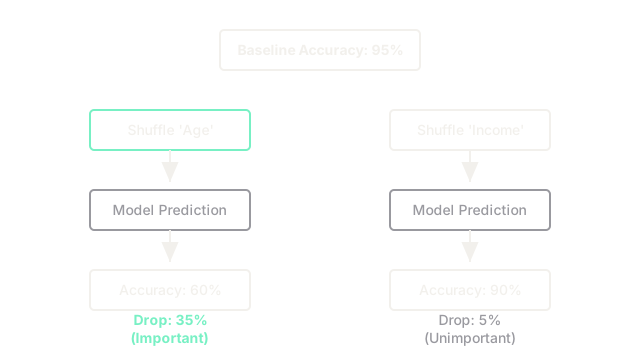
First, you pass your clean validation set through the trained model and calculate your primary metric (e.g., Accuracy, F1 Score, or RMSE). Let's say your baseline accuracy is 95%.
2. Shuffle a Single Feature
Next, you select one feature column (e.g., Age). You take all the values in that column and randomly shuffle them. John, who is 25, is now assigned the age of 68. Mary, who is 68, is now assigned the age of 12.
Crucially, you leave all the other columns (Income, Education, etc.) perfectly intact. By shuffling Age, you have completely destroyed the relationship between Age and the target variable, while preserving the statistical distribution of the Age column itself.
3. Measure the Drop
You pass this corrupted dataset back through the model and recalculate the accuracy.
- If the accuracy drops from 95% to 60%, the model relied heavily on
Age. The Permutation Importance forAgeis . - If the accuracy only drops from 95% to 94%, the model barely used
Age. The Permutation Importance is .
4. Repeat
You restore the Age column, pick the next column (Income), shuffle it, and measure the drop. You repeat this loop until you have calculated a score for every feature in the dataset. You then sort the features by their score, giving you a mathematically sound, global ranking of feature importance.
Code
Because permutation importance is model-agnostic, you can write a simple implementation from scratch using Pandas and scikit-learn metrics.
import numpy as npimport pandas as pdfrom sklearn.metrics import accuracy_score
def calculate_permutation_importance( model, X_val: pd.DataFrame, y_val: pd.Series) -> pd.DataFrame: """Calculates permutation importance for all features.""" # 1. Calculate Baseline baseline_preds = model.predict(X_val) baseline_acc = accuracy_score(y_val, baseline_preds) importances = [] # 2. Iterate through each feature for col in X_val.columns: # Create a copy of the validation set to corrupt X_corrupted = X_val.copy() # Randomly shuffle this specific column X_corrupted[col] = np.random.permutation(X_corrupted[col]) # 3. Measure the Drop corrupted_preds = model.predict(X_corrupted) corrupted_acc = accuracy_score(y_val, corrupted_preds) drop = baseline_acc - corrupted_acc importances.append({"Feature": col, "Importance (Drop)": drop}) # 4. Sort and return df = pd.DataFrame(importances) return df.sort_values(by="Importance (Drop)", ascending=False)Watch Out For
Correlated Features (The Co-dependence Trap)
Permutation importance fails gracefully if two features are highly correlated (e.g., Birth Year and Age). If you shuffle Age, the model might not suffer a massive accuracy drop because it can simply fall back on Birth Year to get the same information. As a result, both features will report an artificially low importance score. Always remove or combine highly correlated features before running this analysis.
Testing on the Training Set
Never run permutation importance on your training data. A heavily overfitted model will show high importance for noise features (like User ID) on the training set because it memorized them. You must run permutation importance on unseen validation or test data to see which features the model actually uses to generalize to the real world.
The Quick Version
- Permutation importance is a model-agnostic technique for global explainability.
- It calculates importance by randomly shuffling a single feature's data and measuring how badly the model's performance degrades.
- A massive drop in performance means the feature was critical; a tiny drop means the feature is useless.
- It is significantly more reliable than the built-in feature importance algorithms found in decision trees, which are biased toward high-cardinality features.
- It struggles with highly correlated features, as the model can bypass the shuffled feature by relying on its twin.