Task-Specific Evaluation Design
Public benchmarks tell you if a model is generally smart, but they cannot tell you if it will succeed at your specific business use case. You must build your own private evaluation.
Why Does This Exist?
When a new foundation model is released, the creators publish a table of benchmark scores: 88% on MMLU, 94% on GSM8K, and 82% on HumanEval. These numbers are useful for researchers tracking the frontier of general intelligence, but they are almost entirely useless for an engineer trying to ship a product.
If you are building an AI agent to parse complex medical insurance claims, knowing that a model can solve high-school algebra (GSM8K) does not guarantee it can extract billing codes correctly. Furthermore, public benchmarks are heavily contaminated (the models memorized them during training), meaning their scores are artificially inflated.
Task-specific evaluation is the practice of building a custom, private benchmark tailored exactly to the problem your model needs to solve in production. It is the only reliable way to know if a model is ready to be deployed, and it is the only way to measure if your prompt engineering or fine-tuning efforts are actually moving the needle.
Think of It Like This
Think of public benchmarks like an applicant's SAT score, and a task-specific evaluation like a technical interview.
If you are hiring a senior software engineer, you might glance at their university grades or standardized test scores to ensure they have a baseline level of general competence. But you would never hire them based solely on their SAT score.
Instead, you give them a coding challenge that closely mirrors the actual work they will be doing on your team. A high SAT score does not guarantee they know how to debug a Kubernetes cluster. You build a task-specific technical interview to measure exactly what you need.
How It Actually Works
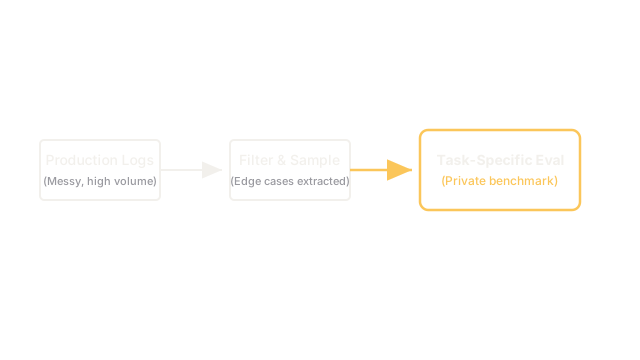
Building a task-specific evaluation is heavily reliant on data engineering and human annotation. It follows a lifecycle that begins with production data and ends with a hardened, automated test suite.
1. Sourcing the Data
You cannot write a good evaluation set from scratch in an afternoon. Humans are notoriously bad at inventing realistic edge cases; we tend to write examples that are too simple or too rigidly formatted.
The best task-specific evaluations are built by sampling real production logs. If you have an existing system (even a non-AI system, like human customer support transcripts), you sample hundreds of real inputs. This guarantees that your evaluation set will perfectly match the messy, typo-ridden, unpredictable distribution of data your model will actually face.
2. Stratification and Slicing
A random sample of production logs will be dominated by easy, common queries. If you use a purely random sample, your benchmark will be too easy, leading to benchmark saturation.
To make the evaluation robust, you must actively stratify the sample. You deliberately over-sample known failure modes, complex edge cases, and rare cohorts (as discussed in slice-based-evaluation). If your system handles 10 different languages, you ensure all 10 are represented equally in the test set, even if 9 of them only account for 1% of production traffic.
3. Establishing Ground Truth
Once you have your inputs, you must establish the "correct" answers. This requires rigorous human-evaluation-protocols. You write a strict rubric and have domain experts annotate the inputs. If the task is medical parsing, you hire medical coders to provide the ground truth, not crowdsourced generalists.
4. Designing the Custom Scorer
Finally, you must write the code that compares the model's output to the human ground truth. If the task is classification, a simple exact match might work. But if the task is generative (e.g., summarizing an insurance policy), you must design a custom llm-as-a-judge prompt that grades the summary specifically on the criteria your business cares about (e.g., "Did it mention the deductible? Did it hallucinate coverage?").
Code
Here is a conceptual example of a custom scorer designed for a highly specific business task: extracting a JSON payload of actionable items from an email, while explicitly penalizing hallucinations.
import json
def task_specific_json_scorer( model_output: str, ground_truth_keys: set) -> dict: """ A custom scorer for an extraction task that strictly penalizes hallucinated keys. """ try: parsed_output = json.loads(model_output) predicted_keys = set(parsed_output.keys()) except json.JSONDecodeError: return {"score": 0.0, "reason": "Invalid JSON"} # Calculate precision (penalizes hallucinations) correct_keys = predicted_keys.intersection(ground_truth_keys) if len(predicted_keys) == 0: return {"score": 0.0, "reason": "Empty JSON object"} precision = len(correct_keys) / len(predicted_keys) recall = len(correct_keys) / len(ground_truth_keys) # Task specific logic: We care deeply about not missing items (recall) # but we will fail immediately if precision drops below 80% # to prevent hallucinated actions. if precision < 0.8: final_score = 0.0 else: # F1 Score final_score = 2 * (precision * recall) / (precision + recall) return {"score": final_score, "precision": precision, "recall": recall}Watch Out For
Testing on the Training Set
If you use your private evaluation set to write few-shot prompts or to perform supervised fine-tuning, you have contaminated your own benchmark. The model will score artificially high, and you will deploy a broken model to production. Always maintain a strict, air-gapped holdout set that engineers are not allowed to look at while tuning the model.
Static Benchmarks Decay
Production data distributions drift over time. Users change their behavior, businesses launch new products, and APIs update. A task-specific evaluation built in January will be obsolete by September. You must build a pipeline that continuously samples new production failures and adds them to the evaluation suite to prevent benchmark decay.
The Quick Version
- Public leaderboards measure general intelligence; they do not predict how well a model will solve your specific business problem.
- A task-specific evaluation is a private, custom-built test suite tailored exactly to your domain.
- The best inputs for a custom evaluation are sampled directly from messy, real-world production logs, not invented by engineers.
- You must actively over-sample hard edge cases to ensure the benchmark actually tests the limits of the model.
- Because it is private, a task-specific evaluation is the only test guaranteed to be free of training-data contamination.